At two in the morning, you typed in Google “what is forex,” did you? Don't worry, you're not alone. The foreign exchange market is essentially the largest money bazaar in the world. Millions of dollars change hands every day, faster than news travels in a college hostel. It is a 24/5 party that involves Tokyo, London, and New York, its fancy suits, and ringing bells.
It might make a beginner feel intimidated by the concept of trading currencies. However, at its essence, forex is simply buying one currency and selling another, such as buying euros and selling U.S. dollars. It aims to generate profits from variations in their relative value.
We do not complicate this at Primefx Signals; we provide straightforward trade signals that are easy to follow and act on.
Beginners can follow systematic advice that combines technical and fundamental analysis with risk management, rather than guessing when to buy or sell. In this manner, forex will be more of a business than a gamble.
What is Forex
The international market of traded currencies is known as forex, or foreign exchange. It is also known as the foreign exchange market (FX).
Here are the essentials:
Definition: Forex is the practice of buying and selling currencies to profit from price fluctuations.
Players: Banks, hedge funds, corporations, governments, and millions of retail traders.
Accessibility: Open 24 hours a day, five days a week, with three major trading sessions: Asia, Europe, and North America.
Scale: Forex is the world's largest and most liquid financial market, with trillions traded every day.
Since currencies underpin international trade, whenever a company imports goods, travels abroad, or invests in another country, it does so through currency exchange. This sustained pressure creates speculation and opportunities for profiteering.
Forex is not a market per se, but a business ecosystem. When people search for "what is the forex business" or "what is the forex industry," they are asking about the broader framework that supports trading.
The forex business involves:
Banks and Institutions: The interbank market determines the exchange rates and liquidity.
Brokers: These systems match the retail traders with the market. They do spreads, commissions, or swaps.
Traders: Individuals and companies that speculate on currencies.
Signal Providers (such as Primefx): These services advise traders on when to enter, take profits, and set stop-loss levels.
Educational sites: Websites, programs, and forums that provide information on the fundamentals of forex.
Think of forex as an international money system. Each one has a role to play: setting prices by the banks, making trades by the brokers, issuing predictions by the analysts, and executing their decisions by the traders.
When beginner traders ask what forex trading is and how it works, the answer is to understand how currency exchange works.
Forex trading is simply that of buying one currency and, at the same time, selling another. Each transaction involves a currency pair, e.g., EUR/USD. If you expect the euro to appreciate against the U.S. dollar, you purchase EUR/USD. Sell EUR/USD if you expect it to weaken.
The following are the steps involved:
Quote system: Quotation is in pairs (base vs. quote).
Price change: When EUR/USD moves from 1.1000 to 1.1050, the euro has gained 50 pips against the dollar.
Execution: Trades are executed via brokers, which is common on platforms such as MetaTrader 4 or 5.
Profit/loss: Calculated as the difference between entry and exit price, multiplied by lot size.
Forex is never traded on an individual basis; it is traded in pairs, where the value of one currency is expressed in terms of another. These are the crucial pairs to understand when one is a beginner and is searching the internet for what forex currency trading is or what the forex trading market is.
Majors: The famous kids—EUR/USD, GBP/USD, and USD/JPY. Everyone wants to hang out with them.
Minors: The artsy kids—EUR/GBP, AUD/JPY. Less popular, but still fun.
Exotics: The exchange program students—USD/TRY, EUR/SEK. They’re unpredictable and sometimes a little too wild.
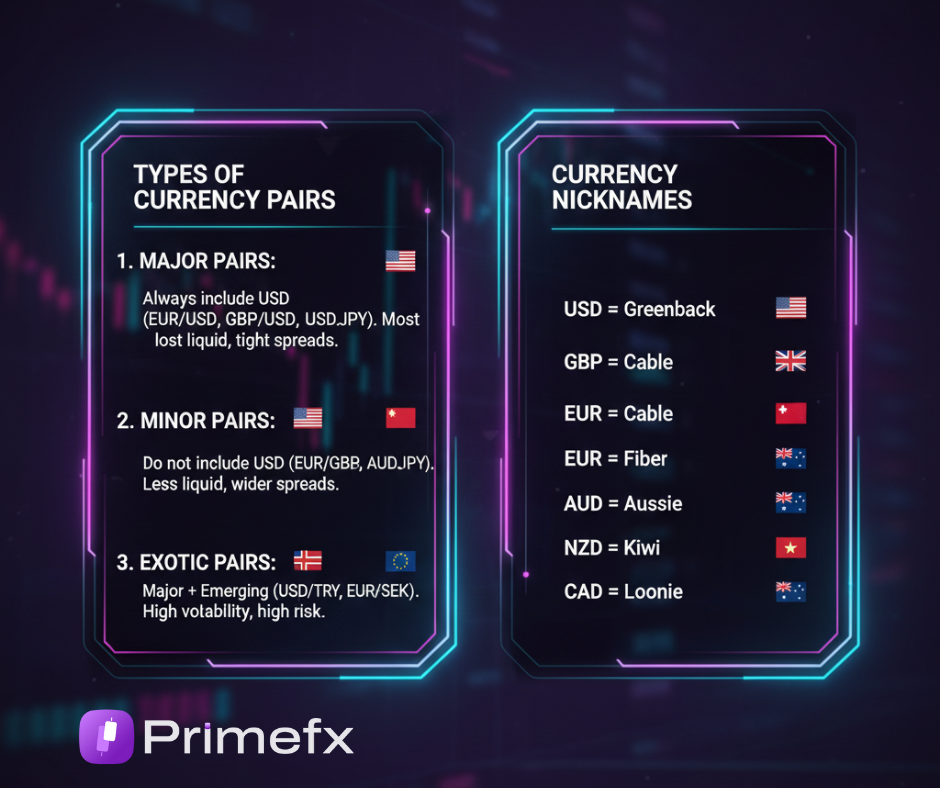
Nicknames help too: USD is the “Greenback,” GBP is “Cable,” and EUR is “Fiber.” It’s like giving your pets nicknames so you don’t forget who’s who.
Primefx Signals Tip: We prioritize major pairs in our signals because they are more predictable, cost‑efficient, and beginner‑friendly. Exotic pairs may look attractive but often carry hidden risks.
The most frequently asked first-time questions include when the forex market opens and when it closes. The forex market is unique in that it is open 24 hours a day, with the week starting and ending on different days across global financial centers.
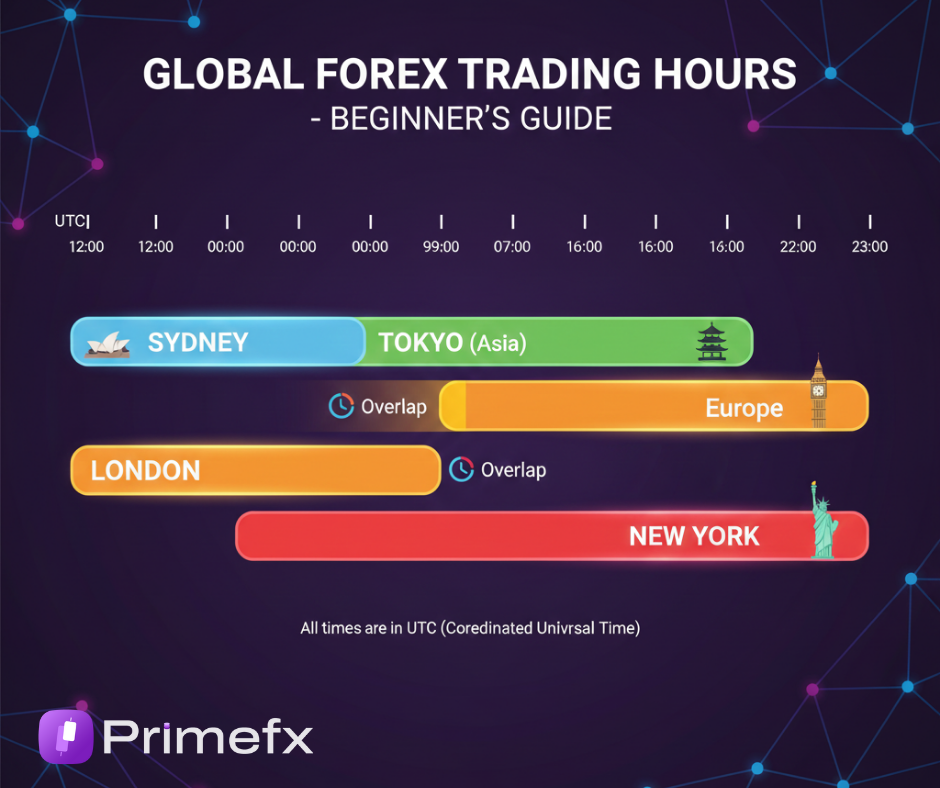
Asian (Tokyo): Peaceful atmosphere; yen pairs are dancing like a slow chant.
London (European): Like espresso shots, volatility soars & charts begin to dance.
New York (North American): Coffee buckets all over, USD pairs gain momentum.
The Overlap: It is as if 2 DJs were mixing music when two markets, London and New York, are trading simultaneously. Here, liquidity gets insane!
It depends on the liquidity and volatility in the time zone.
The most significant trading opportunities are usually created by overlaps (London and New York).
Beginners ought to make trading correlate with their sessions, which are in line with their lifestyle and the pairs of their choice.
Interest Rates: Central banks are the authority figures. They increase rates and their currency starts to appear attractive.
Economic Indicators: GDP, CPI, and NFP are the country report cards.
Geopolitics: Trade wars, elections, and wars. Consider them as a twist on a plot in a Netflix show.
Speculation: 90 percent of forex consists of traders guessing at what comes next. It is like a game of dice as to who will survive the next episode of Game of Thrones!
Trading Styles: Choose Your Adventure
Beginners often ask which forex trading style or strategy to use. The reality is that there is no one-size-fits-all. The style depends on risk tolerance, time availability, and personality.
Day Trading: Thrill seekers. Blink, and you miss it.
Swing Trading: Chill but strategic.
Position Trading: Big-range, long-term investors. They are the philosophers of forex.
Scalping: Trades are tiny and stressful.
PrimeFx Signals tip: Swing and day trading are easy to use- like training wheels before you take the Tour de France.
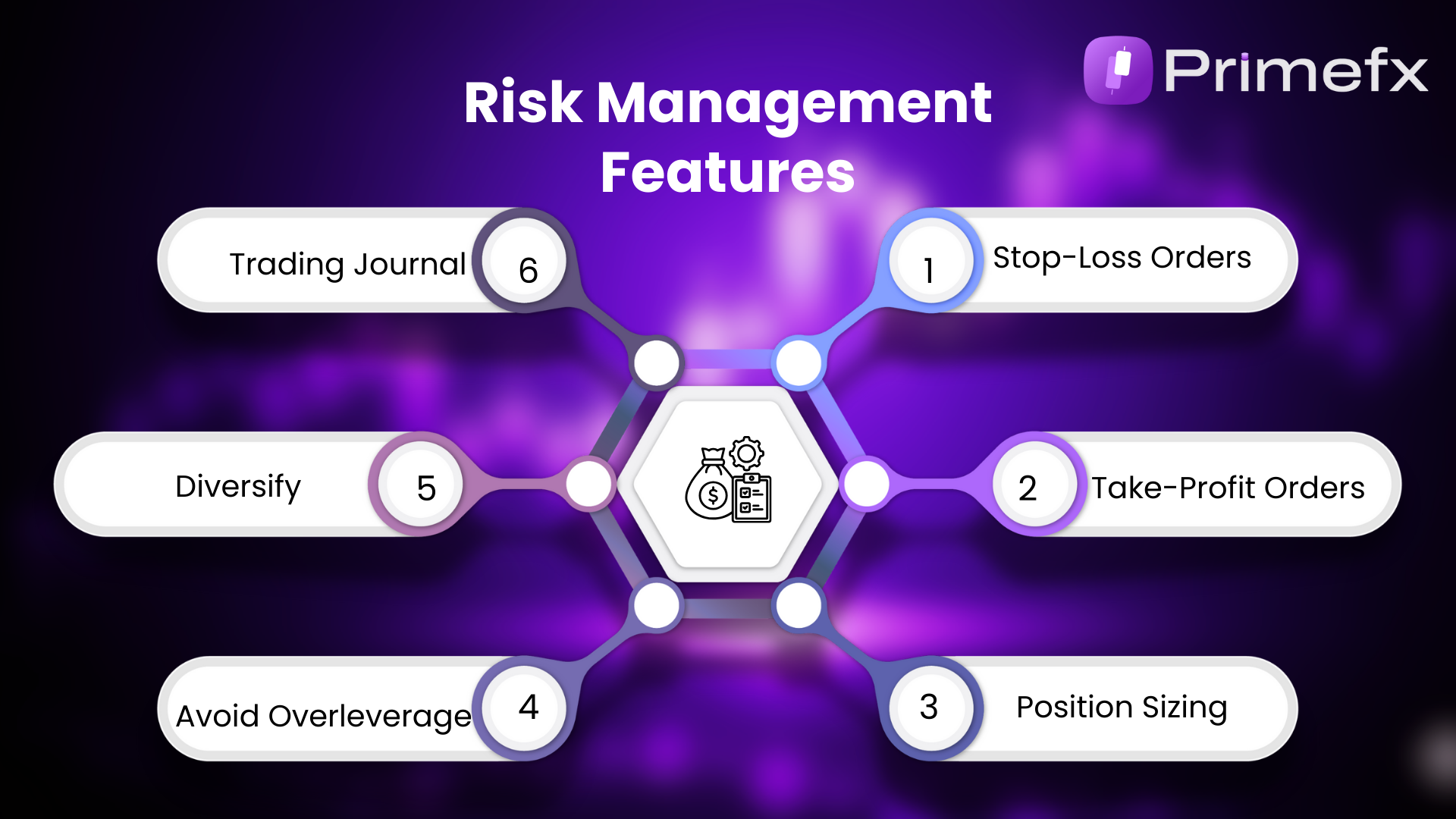
In the search query of "what is forex risk" or "what is margin in forex trading," the answer is quite simple: risk management is the key to successful trading. Its absence indicates that the best strategy has failed.
Stop-Loss Orders: Your panic brakes.
Take-Profit Orders: Your lap of victory.
Position Sizing: Bet the farm—bet no more than 1-2% per trade.
Avoid Overleverage: When you borrow too much, it is like driving your friend’s car at 200 miles an hour and finding out that it is not fun anymore.
Keep in mind: Professionals lose trades as well; only they can survive because they use seatbelts. Amateurs? They crash without one.
Forex is volatile. Experts lose trades, but they endure because of their ability to manage risk. The amateurs usually fail because they risk making money without safeguarding capital.
A common question among beginners is, what is psychology in trading? The reality: strategy is not always better than mindset. Good setups are destroyed by emotions such as fear and greed.
The Making of Overleveraging Like a Rockstar
It feels that money-lending is very strong, until the market coughs and the money in your account disappears. Maintain a low leverage. It is not a superhero cape; it is a parachute.
Trading Without a Stop-Loss
It is like playing Russian roulette. Sure, you may have a good time on a ride till you hit a wall. Never leave one, even when you feel that you will be keeping a close watch on the charts.
Revenge Trading
Lost a trade? Do not run back like a knight with a score to settle. The market does not feel your feelings. Take a step aside, clear your head, and start over.
Falling in Love with One Pair
Yes, EUR/USD is beautiful, but do not get married to it. Diversify. There are other couple of pairs, and some may be kinder to you.
Ignoring the Journal
Leaving out your journal on trading is just like leaving out gym warm-ups; you will regret it in future. Record your trades, even the humiliating ones. Future-you will thank you.
Solution? Keep your strategy, apply stop-loss, and keep in mind, forex is a marathon, not a sprint.
MetaTrader 4/5 (MT4/MT5): Nokia of trading platforms—solid, dependable, and not as flashy as the new kids.
WebTrader: Internet-based quick access.
Mobile Apps: Buy and sell through iOS/Android apps.
Economic Calendars: Track economic events, including interest rate and NFP announcements.
Primefx Signals: Your cheat sheet—understandable calls, stop-losses, and definitions so you do not panic-trade at 3 a.m.
For beginners who are asking, "How do I start forex trading?" or "What is forex business to me?" Primefx has provided guidelines.
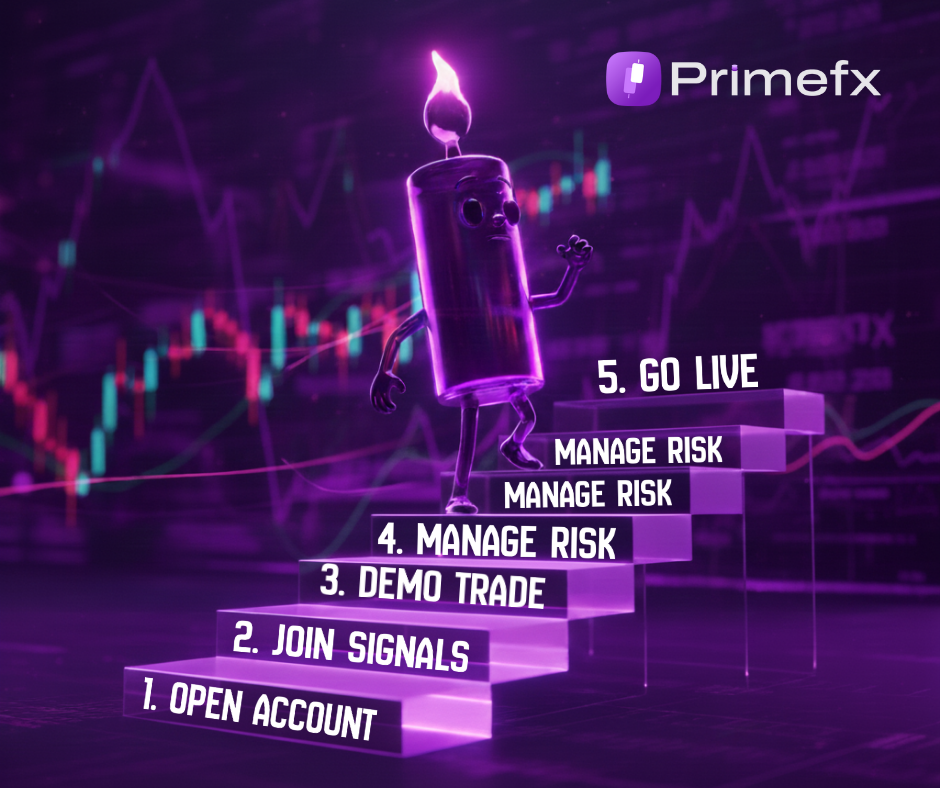
Open a controlled brokerage account (MT4/MT5 compatible).
Subscribe to Primefx Signals to have real-time trade ideas.
Trade on a test account before you gamble using real money.
Use strict risk management (1-2% per trade).
Switch to live trading, beginning with key pairs.
Blended Analysis: Signals combine technical indicators and fundamentals.
Risk Management Built In: All signals include stop-loss and take-profit levels.
Session-Specific Signals: Timed to coincide with the peaks of liquidity (London-New York overlap).
Educational Value: Signals are accompanied by traders' notes that explain the rationale for each call.
Confidence Boost: Beginners avoid emotional errors thanks to clear guidance.
Forex is not a casino; it is structured chaos using spreadsheets. There is a way to trade your mind without losing it: using signals, managing risk, and a bit of humor.
We are Primefx Signals, and our roadmap is clear signals, risk management, and education. Forex is not a game of guessing, and it is a matter of discipline, organization, and education.
Purchase Primefx Signals, and you can transform forex, a fear-inducing monster, into a business that you can laugh at.
What are the basics of forex trading?
Forex trading is the process of selling a given currency and buying another with the intention of making profits as the exchange rate between the two currencies changes. Beginners should begin by understanding the terms "currency pairs," "pips," "lot size," "leverage," and "risk management."
How can I learn the basics of forex trading?
Begin with free educational materials, demo trading accounts, and prepared signal services such as Primefx. Before going live, it is essential to learn the charts, the economic indicators, and the trading psychology.
What should a beginner trade in forex?
The most useful currency pairs, such as EUR/USD and GBP/USD, are liquid and have low spreads, making them suitable for beginners. Primefx Signals typically target these pairs because they are reliable and easy to execute.
What is the 5-3-1 rule in forex?
It is a discipline-based strategy: 5 currency pairs, 3 trading strategies, and one trading session. It helps reduce overload and improve consistency.
What is the 90% rule in forex?
The notion that 90 per cent of traders lose money because they fail to manage their risk and act on emotion. It can be avoided by following systematic cues and trading strategies.
What is a pip in forex?
The smallest price change in a currency pair is called a pip, typically 0.0001. It is applied to determine either gains or losses in trade.
What lot size can I trade with $100?
In this case, you should stick to micro lots (0.01) with a $100 limit, as it will help you manage risk and avoid overleveraging.
How should one begin trading forex?
Open a regulated broker account, subscribe to an analysis signal service such as Primefx, trade on a demo account, and learn the basics of analysis and risk management.

Sofia Alvarez is a professional market analyst and trading educator at PrimeFX Signal, with over 8 years of experience in Forex, Gold (XAUUSD), and major indices. She specializes in price-action and risk-managed swing trading, combining technical analysis, macro news, and strict risk controls to build clear, rules-based strategies for retail traders. At PrimeFX Signal, Sofia oversees trade ideas, reviews performance data, and writes in-depth guides on risk management, broker selection, and trading psychology so traders understand not just the signals but the logic behind every setup. Outside of market hours, she mentors developing traders through webinars and Q&A sessions, focusing on discipline, transparency, and sustainable long-term results in highly volatile markets.