I was overly excited when I first entered the world of forex signals. The providers appeared to offer multiple take-profit and stop-loss levels and numerous rules for partial closes.
Though such complex setups looked impressive, they often produced distorted results in reality. Such complexity leads to many errors for someone with a busy schedule or a beginner.
In today's market, simplicity matters most. So far in 2026, the year has been marked by high volatility, driven by divergent central bank policies and systematic dollar selling. Such actions indicate continued dollar weakness and significant moves in the major pairs.
In this case, where policy changes are common and can cause abrupt shifts, a clear SL-TP format minimizes execution errors and keeps trading on track.
Gradually, I learned something simpler and easier to understand. I was introduced to the 1 SL - 1 TP model, which keeps me disciplined and prevents confusion during trading.
Throughout this blog, I will take you through the meaning of the 1 SL -1 TP format, the importance of the service, and how Primefx Signal delivers it transparently and consistently, rather than focusing on false claims.
Think of a trader who buys EUR/USD at 1.655 and has a stop-loss at 1.650 and takes a risk of 50 pips. The signal provider sets three take-profit levels: TP1 at 1.660 (+50 pips), TP2 at 1.665 (+100 pips), and TP3 at 1.670 (+150 pips).
The trader might sell a third of the position at TP-1, then a third at TP-2, and the final third at TP-3, provided the market continues moving in the same direction.
If the market moves against TP-1 and the stop-loss is triggered, the trader will still have a partial gain on the initial position. Nevertheless, the net result can be zero or near-profit.
In comparison, the 1 TP -1 SL format makes it simple. This trader enters at 1655, places a stop-loss at 1650, and sets a take-profit at 1665.
At the price, would the entire position be closed with a 100-pip profit, or would the trade be closed with a 50-pip loss when the stop-loss is hit? The outcome is crystal clear.
Redefining theoretical definitions,
SL (Stop-Loss): The price at which the trade will be closed if the market moves against me.
TP (Take-Profit): The price at which the trade will be closed if the market moves in my favour.
A 1 SL-1 TP signal implies that I have only one clear exit point, either in loss or in profit. In this format, you do not need to work with many targets at once and never finish a half-close. There is but one clear and definite way to your decision.
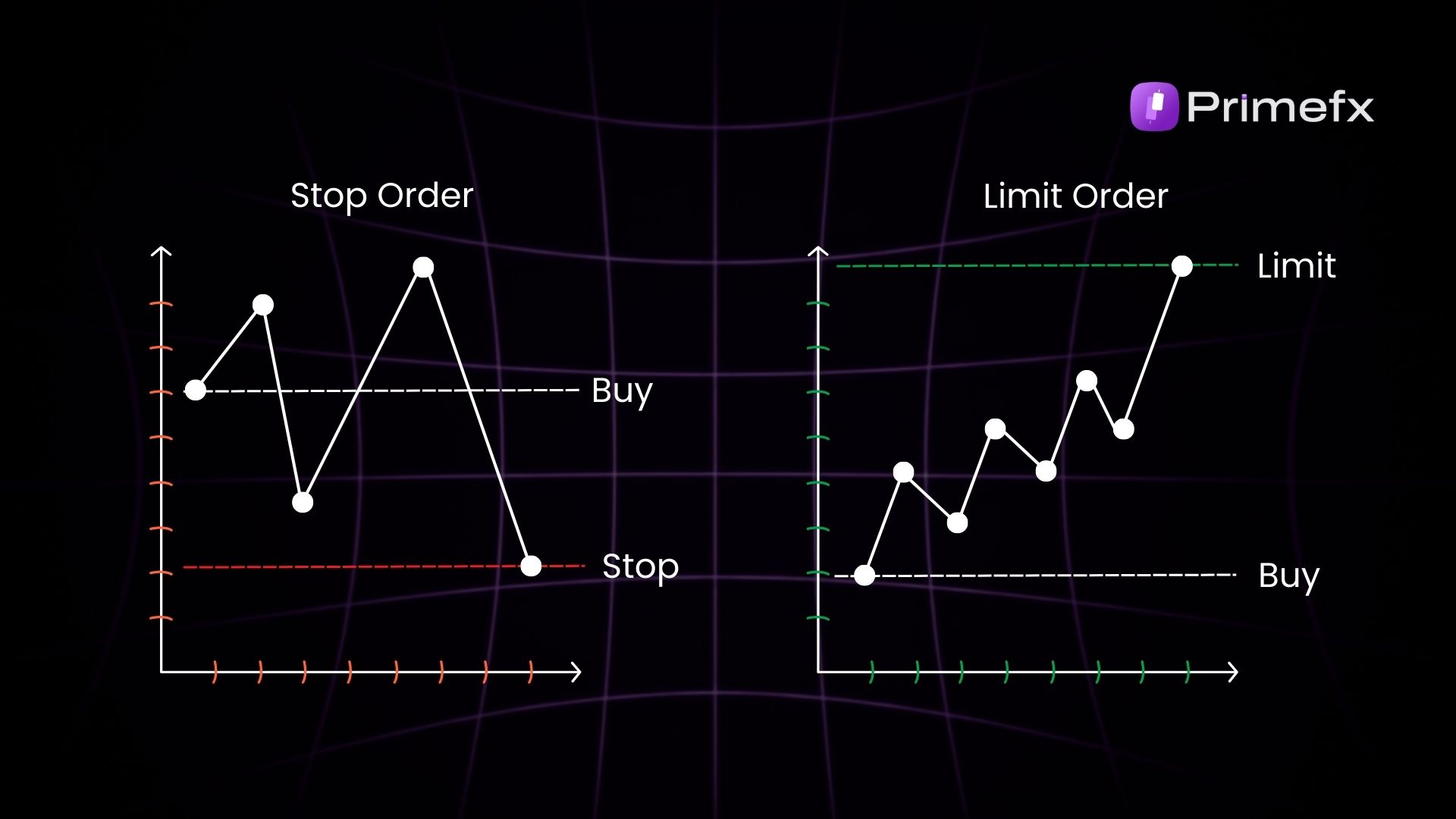
On all things, the well-developed signal must have a clear spell:
Pair: EUR/USD or XAU/USD (Gold)
Direction: Buy or Sell
Entry: Precise price or entry zone.
Stop Loss (SL): Defined level
Take Profit (TP): Defined level
Others have the time validity and risk notes, e.g., trade at 1 percent risk, to enhance discipline.
Less pressure in decisions: Does not have to deal with half a close or half a target.
Improved performance reporting: Win/loss measures are easier to take.
Better when starting out: Less likely to make errors in executing a move, such as forgetting to move SL or selecting the wrong TP.
Aspect | Multi‑TP | 1 SL – 1 TP |
Complexity | High; multiple exits | Low; 1 clear exit |
Execution | Needs active management | Simple |
Tracking | Blended, less transparent | Clear win/loss outcome |
Best for | Advanced traders | Beginners & busy traders |

Trading without risk management is nothing less than gambling. So, Risk-to-reward (R: R) is the backbone of trading discipline.
Let's assume two friends are watching a cricket match, supporting opposing teams. One friend says, "I bet $100 on my team. If they score a single, I take $30; if four, $60; and $100 if they hit a six. In case they get out, I will give away $50 as my loss.”
Isn't this sound complicated? That is the case with multiple SL and TP.
Consider another situation in which two friends make a simple bet of $100: if the team wins, they profit $200; if the team loses, they lose $100.
In the first scenario, you are left with your head spinning, wondering what counts as a win or a loss. But the second comes with clear aspects and a certain outcome: win big or lose small.
That is why anchoring trades in a 1:2 risk-to-reward ratio is essential. Risking $100 to aim for $200 keeps one focused and disciplined.
Primefx Signal is built on the same principle: simple signals, structured risk. It is a framework that rewards patience and consistency.
Signals do not exist in a vacuum; they react to the larger market. At present, the Federal Reserve has maintained the levels at 3.75% following a reduction in December.
The Bank of Japan remains cautious about the weak yen and is monitoring it closely. USD sales remain systematic, with flows rotating into GBP, AUD, and CAD.
EUR/USD and AUD/USD are technically above their 200-day moving averages, while USD/CHF and USD/CNH are trading below theirs.
AT present, volatility is becoming increasingly acute because of the policy divergence, so this is making clear SL and TP levels more significant than ever.
A simple format minimizes execution errors in such circumstances.
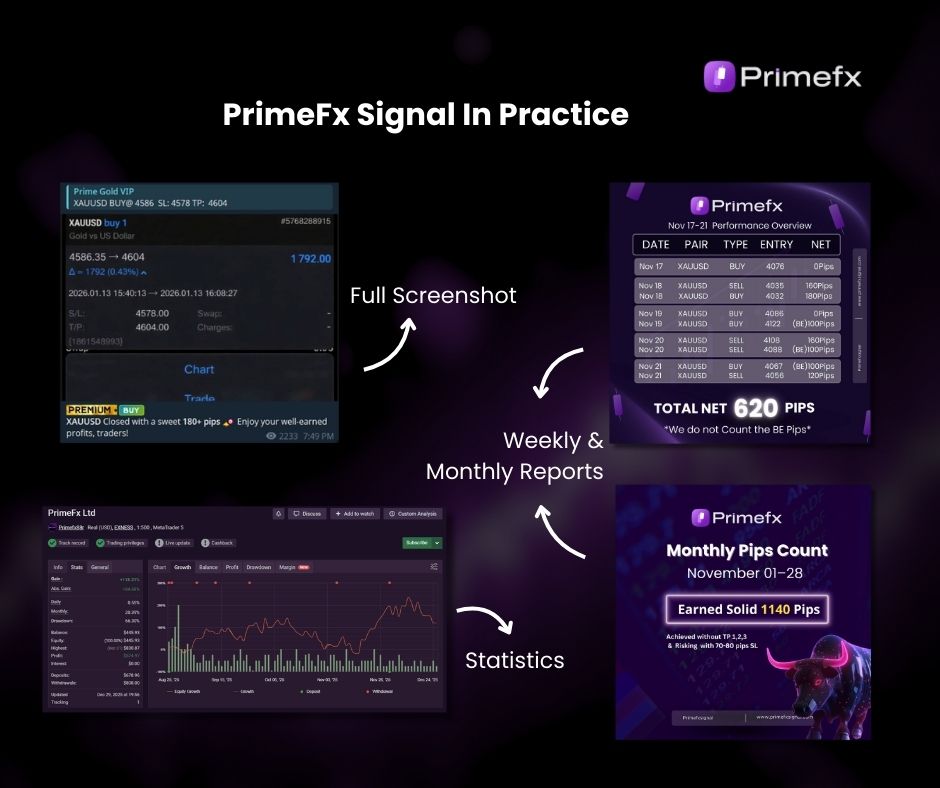
Primefx Signal is built on the 1 SL – 1 TP format, keeping execution straightforward and user‑friendly. What sets them apart is not just the clarity of the signals but also the way they demonstrate our performance.
All trades are supported by weekly and monthly reporting with full screenshots, the number of pips, and statistics on win rates.
It is not only marketing but verifiable facts that traders can follow with the same precision as in their own statements.
Wondering how Primefx uses the 1 SL -1 TP technique to trade in real trades? Check out the Primefx Signal for specific examples.
In addition to the trades, Primefx is transparent about its approach and reporting structure. Their performance and reporting page presents the figures in black and white. This further supports the conclusion that the results are not overstated by tricks such as partial closes or blended results.
In my case, this openness creates trust. It is hard to find a trading world as full of flashy marketing strategies as Primefx's. They make their signals user-friendly and back up all their claims with concrete data.
And in unstable markets, where discipline and trust are of utmost importance, such simplicity and transparency are worth their weight in gold.
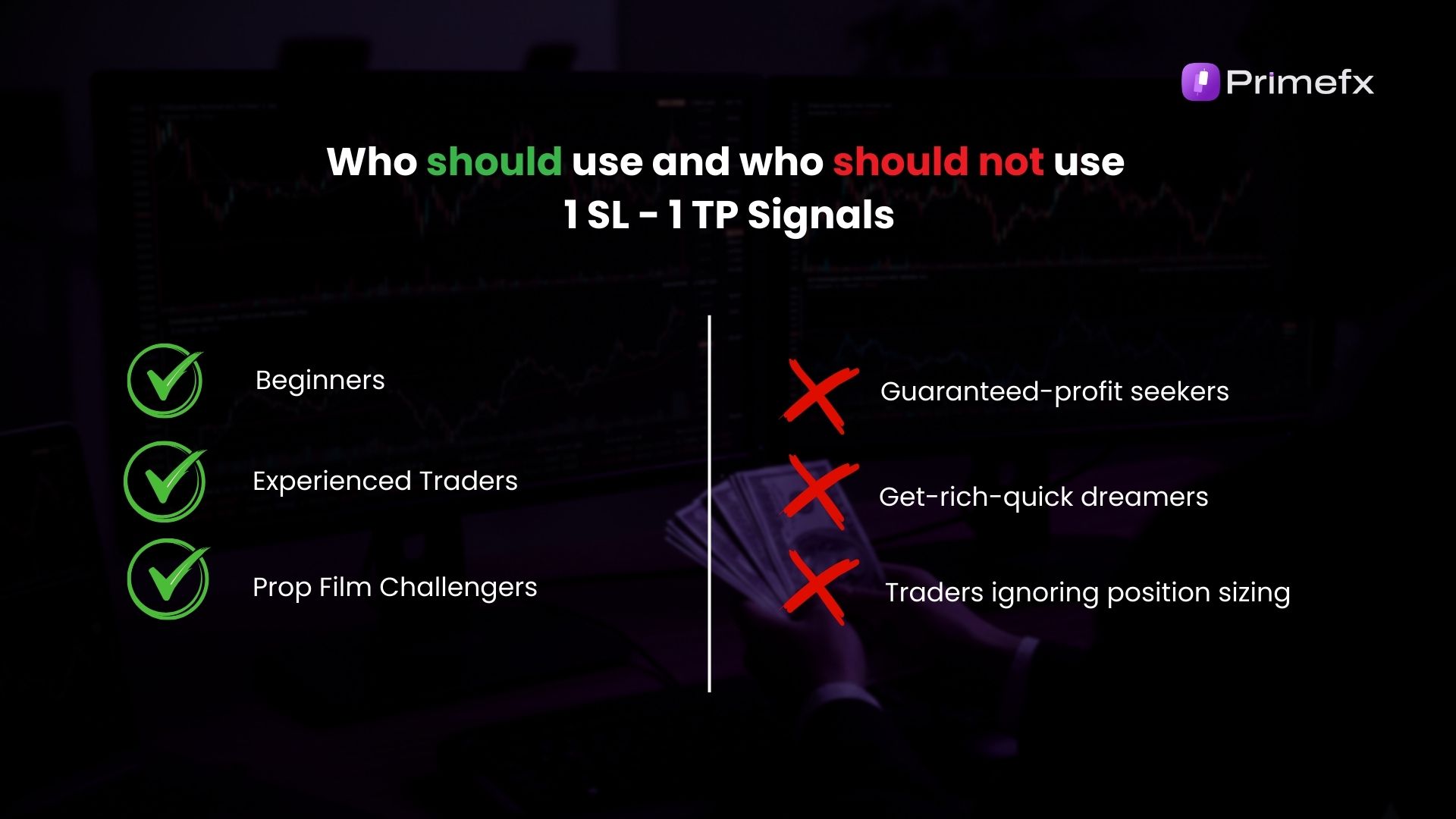
Signal services do not fit all sizes. Primefx Signals is designed specifically for a particular type of trader. Moreover, it is important to identify who will succeed with this strategy and who may not.
Beginners:
Primefx is your first time in trading, and you need an easy time? It is like having a guide. One stop-loss, one take-profit allows you to develop discipline at day one. Here, there are no confusing halfway-closes or various target levels.
Experienced Traders:
Primefx will be attractive to experienced traders who value transparency. It is not only the performance that is promised but also proven through weekly and monthly reports, win-rate statistics, and trade records.
Responsibility and professionalism are integrated in the process.
Prop Firm Challengers:
The fixed SL-TP structure is a lifesaver for those preparing to test a prop firm. It is predictable, uniform, and has a well-defined risk structure, exactly what is required to satisfy high evaluation standards.
In short, Primefx will suit traders who value clarity, trust, and responsibility, and who prefer discipline to empty promises.
The other side of the coin is that Primefx does not suit everybody. And if you are looking to make sure profits, you will be disappointed. No signal provider can eliminate the risk. Nor will overleveraged or risk-blind traders do so well here.
The 1:2 risk-reward ratio will only be effective if you exercise discipline in position sizing and across your accounts.
And even when you are dreaming about get-rich-overnight shortcuts, Primefx will be too real. This service is designed specifically for targeted traders who view trading as practice rather than a lottery ticket.
Having experienced the process of stumbling in the field of signal formats, I can say the 1 SL -1 TP structure feels like a breath of fresh air. It removes noise, maintains trading discipline, and makes execution much easier, particularly when traders are busy and do not have time for multiple targets or partially closed executions.
This simplicity is more than convenient; even the most expert is liable to wild market fluctuations.
Primefx Signal does not simply market this framework; it also supports it with transparency. Weekly and monthly reports, along with the number of pips, win rate, and trade screenshots, ensure performance is not measured by marketing gimmicks.
Such transparency builds trust, especially in a trading environment where claims are often inflated. As we understand it, trust is a more valuable commodity than a pip count.
To see this method in practice, you can go through their free Telegram community and VIP plans. Whether you are a beginner who likes a framework or an advanced trader looking to be accountable, Primefx's 1 SL - 1 TP signals are a smooth move. The kind that respects order, discipline,e and openness more than any other factor.
CTA: If you’re tired of juggling complex signal formats and want a trading style that values clarity, discipline, and transparency, it’s time to experience the Primefx 1 SL – 1 TP approach.

What do SL and TP mean in forex signals?
SL stands for stop-loss, the level at which a trade closes if it goes against you. TP stands for take-profit, the level at which a trade closes in profit.
Are 1 SL–1 TP signals good for beginners?
Yes. They provide clarity and reduce execution mistakes. Beginners benefit from having one clear profit and one clear loss level.
Are 1 SL–1 TP signals “safer”?
Not “safe”; risk always exists. But simpler rules reduce confusion and help avoid common mistakes.
Do 1 SL–1 TP signals work for XAU/USD (Gold)?
Yes, but gold is volatile. Risk rules matter even more. Always size positions carefully.

Sofia Alvarez is a professional market analyst and trading educator at PrimeFX Signal, with over 8 years of experience in Forex, Gold (XAUUSD), and major indices. She specializes in price-action and risk-managed swing trading, combining technical analysis, macro news, and strict risk controls to build clear, rules-based strategies for retail traders. At PrimeFX Signal, Sofia oversees trade ideas, reviews performance data, and writes in-depth guides on risk management, broker selection, and trading psychology so traders understand not just the signals but the logic behind every setup. Outside of market hours, she mentors developing traders through webinars and Q&A sessions, focusing on discipline, transparency, and sustainable long-term results in highly volatile markets.