Imagine auditioning for the markets instead of risking your savings. That is what a prop firm challenge is—it is not a lottery; it is a test of discipline. And with Primefx cues at every turn, you are not only practising to hit a target, but you are also getting to a funded stage.
If you pass, you trade firm funds for a generous profit split. If you fail, you lose only the entry fee, not your financial future.
This is more than a general guide. It provides you with a workable system, Quant-style standards, and customer-friendly language that you may use today—no fluff, just what turns the needle.
Why Prop Firm Challenges Are the New Gateway
Prop firm problems are emerging as a new entry point for professional trading, allowing aspiring traders to test their abilities without investing significant capital. Rather than paying a large deposit, you pay a small initiation fee and trade under the firm's stringent regulations.
These regulations are profit goals, drawdown, and timing, aimed at demonstrating that you can achieve consistent returns without harming capital. Passing a challenge is a sign that you are disciplined, reliable, and good risk managers in the market.
For most traders, this is the difference between hobbyists and professionals: credibility is established, expansion is enabled through scaling, and access to firm resources that accelerate success is gained.
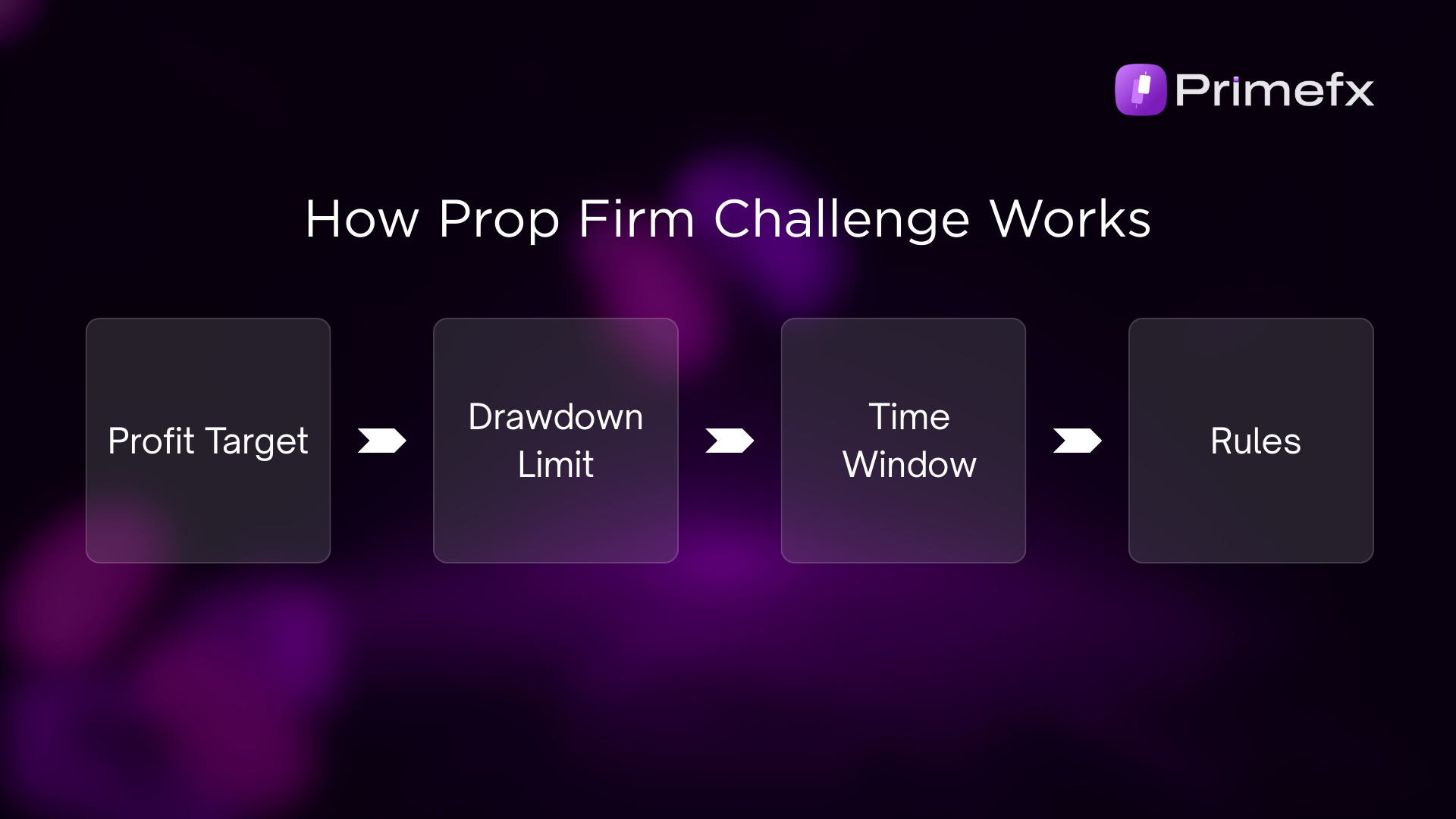
A prop firm challenge is a competitive assessment with defined conditions you must fulfil. Consider it a contract: achieve a profit goal, stay within risk boundaries, and comply with regulations. If you do, you get funded. Otherwise, you get to know and repeat your lesson.
Target profit: Generally fixed at the levels of 6-10% during the evaluation period.
Drawdown limits: It has a daily loss limit (usually 4-5%) and a total cap (usually 8-12%).
Time window: Most programs set a 30-60 trading-day time limit; in others, there is none.
Rules: Restrictions on news trading, holding over weekends, specific instruments, lot sizes, and automated trading (EAs = Expert Advisors).
Passing a challenge at a prop firm has a much greater reward than bragging rights. Proven traders receive funded accounts ranging from $25,000 to $500,000, depending on the program. You can use this capital to trade larger positions and receive a share of the profits—typically between 75% and 95%.
Most companies also have fast payout cycles, i.e., weekly or biweekly. This enhances cash flow and motivation. Firms can increase your account size as you demonstrate consistency. Therefore, you can secure additional capital.
Some also offer training, performance dashboards, and community support to support growth. But the most significant change is psychological: you will no longer prove yourself; you will be a full-fledged professional, a responsible trader, with real money and real expectations.
Passing a prop firm challenge is not about chasing lucky wins; it’s a systems game. It wins because it is a repeatable process that is less emotional and decision-making, and on the downside, it is constructive.
The traders who keep passing are those who treat it as a professional audition and can follow the rules, taking breaks to pace themselves rather than trying to meet deadlines.
Your seatbelt in this ride is at risk. Primefx alerts to remind you: remember to hold every trade at 1-1.5 per cent risk.
In that manner, even a losing streak will not throw you off the track. Trust it as defensive driving; go slow when the road is rough, and you will still get there after all.
Set the daily loss circuit breaker to 3%-4%. Once this limit is reached, stop trading for the rest of the day to avoid emotional volatility. Weekly withdrawals should be limited to 6%-8% to prevent a bad week from wiping out your progress.
Target a risk-to-reward (R: R) ratio of 1:1.5-2, i.e., you will risk $100 to earn $150-$200. This small advantage multiplies quickly across various trades.
Lastly, in case of equity falling by 3-4% in a week, cut the position size by 30-50% until you get back on track. This defensive scaling helps you stay in the game longer, which is key to passing.
Make your entries out of structure rather than out of impulse. Start by tagging sessions as trending or range-bound using higher-timeframe charts. This situation prevents you from navigating the market's natural cycle.
At least three confluence signals will be required before entry, including alignment with the market structure, a significant support/resistance level, momentum confirmation, and volatility context as measured by ATR (Average True Range).
Only trade when liquidity is high, e.g., the London open or the London-New York overlap, when the spreads are tighter, and the moves are cleaner.
Trade should also not be done in the vicinity of high-impact news events when your firm prohibits trading them, or volatility regularly breaks stop levels. This rigorous entry logic eliminates noise and maintains the quality of your trades.

Discipline collides with precision through execution. Insert stops on the outside of conspicuous structural points, with a buffer on ATR, to prevent being beaten off by random volatility.
Scale at 1R and lock in 25%-50% of your position before a longer distance move has been made. Scale out the rest with structure or ATR. If your trading base is broken as the trend changes or a level is breached, exit the trade.
Do not bargain with the market and expect it to go back. Clean execution is the process of ensuring that even losing trades are managed and that winners are maximised without greed.
Routine is used to establish consistency. Every morning, take 20 minutes to map higher-timeframe levels, plot two or three A+ setups, and ensure your risk limits are met.
When live, focus only on such setups, with a maximum of two or three trades per day. This will ensure there is no overtrading and your energy remains sharp.
Journal all trades after the session, including information on the setting, feelings, and adherence to your plan. Keep track of key log statistics, such as win rate and R multiples, then roll over to the next day by preparing new levels.
This discipline, which is the real currency of passing, is brought about by this cycle of preparation, execution, reflection, and reset.
The issues of the prop firms in 2026 are more varied and open than ever. Each company's strengths differ; therefore, the most suitable option depends on trading style and objectives.
Rebel Funding—It has an affordable entry fee of $25 and a scalable capital limit of up to $5,000. Excellent for those starting out and not wanting to take a big risk.
FTMO—Remains the industry leader with a profit target of 10%, good coaching, and credibility. Perfect for well-organized learners who appreciate tutelage.
Topstep is a futures trading firm with access to 32 markets and a 90% profit split. Ideal for traders who use futures.
The 5ers: 6% profit target with no time limit to meet. The most suitable option is for patient, flexible swing traders.
Apex Trader Funding—Future accounts up to $300K and 100% of the initial $25K in profits—a good option for high-volume traders.
But even with the best firms, traders often stumble. Here’s why
Overtrading: Trades to get to the target are not achieved by piling on. Primefx reminds you: quality matters more than quantity.
Revenge trading: Revenge on losses on the basis of emotions only increases the drawdown. Discipline is the antidote.
Size creep: It would be tempting to quietly add lot size once a few wins have been made, but this would add risk. Stick to your plan.
Breaking of rules: Ignoring news blackout rules or holding trades over the weekend is an instant failure. Primefx keeps you on the correct track of solid regulations.
Rushing goals: It is reckless to squeeze 30 days of a challenge into 3 days. To pass, you have to run a marathon and not a sprint.
Trading psychology isn’t a secret indicator; it’s your mindset. Primefx teaches you to pace yourself like a marathon runner. Rejoice in small victories, record your trades, and learn to accept boredom as part of the process.
Professional trading is about waiting for the right note, not rushing to solo.
Reward small achievements, such as sticking to your plan or adhering to your stop-loss.
These small wins build toward long-term success. You can reduce stress by using visualisation techniques. Imagine yourself trading calmly during busy market sessions.
Prop firms are not just appraising profit and loss; they are appraising your behaviour. It is more impressive to have a consistently rising equity curve with small, consistent gains than with spikes.
Companies appreciate traders who follow regulations, as adherence to rules signals reliability and trust. They also seek flexibility—your capacity to adapt when markets start operating in a fluctuating mode rather than a trending mode or when a volatility burst occurs.
Documentation matters too. Maintaining a trading journal, pre-market planning, and jotting down your thoughts are indicative of maturity and professionalism.
In short, companies are seeking traders who can safeguard capital, comply with regulations, and be consistent over the long term.
Prop Firm Myths—Busted with Primefx
Myth 1: You should make huge gains to pass
The truth? It is not about a single big victory. It is the principle of accumulating small, regular profits. Primefx indicators remind you that you can easily achieve most targets with a stable 1-2% weekly profit. Think marathon, not sprint.
Myth 2: Experienced and older traders achieve success
Experience is good, but excessively confident. Beginners who strictly follow instructions, are risk-averse, and remain disciplined tend to beat veterans who take chances.
Primefx provides new players with an outline so they can be smarter, not scream.
Myth 3: Prop firm challengers are frauds
Not true. Companies such as FTMO, Topstep, and The 5ers have a long history of paying out profits. It is no longer about legitimacy but about discipline.
Primefx notifies you of the rules and consistency, rather than conspiracy theories.
Myth 4: Passing is a matter of luck
Fortune will get you a lottery ticket, but not a prop firm test. Consistency, risk management, and discipline are what will get you funded.
Primefx signals are designed to strengthen those habits; you do not make them by chance.
Myth 5: Tools are a guarantee of success
Trading can be much easier with a VPS, a multi-monitor configuration, or elaborate devices, but not at the expense of discipline or psychology.
Primefx never forgets: It isn’t that hardware that matters, but the attitude.
Are you willing to go to the next level of audition? Your opportunity to become a Primefx member starts now. Let our signals guide you through every step of the prop firm challenge so that you can trade with confidence, discipline, and funded capital.
The concepts of trading are abstract, and analogies help make them familiar. A prop firm trial is like trying out for a band. You don’t need one great solo.
You must show that you can work well with others every day.
Risk management is like wearing a seatbelt in your car. You hope you won’t need it. But when the market slows, you will be in a safe position.
These comparisons simplify complex ideas. They help your clients, managers, or colleagues understand your field of study better.
🌅 Morning: Review market news and risk limits to be observed during the day.
📊 Pre-market: Map higher-timeframe levels, set up 2-3 A+ levels, and confirm risk per trade.
🎯Live session: You have to stick to planned setups, do 2-3 trades, and do not enter impulsively.
🌞 Midday: revise open trades, amend stops as required, and defend profits.
🌙 Evening: Backtest structures, analyse performance, and plan levels for the following day.

Running a prop firm is not easy, but it is fair. They are designed to remove impulsive traders and reward those who can capitalise, adhere to the rules, and demonstrate consistency day in and day out.
The key to passing is not luck or secret signs. It is about showing you can control risk. You must manage your emotions well. You should also trade like a professional, even in stressful situations.
When you master these skills, they are no longer a hurdle to a financially successful career but a gateway to it.
The curious fact is this: you can only prove the prop firm challenge by proving yourself. Break your cravings, and the capital of the firm is your platform.

Sofia Alvarez is a professional market analyst and trading educator at PrimeFX Signal, with over 8 years of experience in Forex, Gold (XAUUSD), and major indices. She specializes in price-action and risk-managed swing trading, combining technical analysis, macro news, and strict risk controls to build clear, rules-based strategies for retail traders. At PrimeFX Signal, Sofia oversees trade ideas, reviews performance data, and writes in-depth guides on risk management, broker selection, and trading psychology so traders understand not just the signals but the logic behind every setup. Outside of market hours, she mentors developing traders through webinars and Q&A sessions, focusing on discipline, transparency, and sustainable long-term results in highly volatile markets.