Wall Street professionals are no longer the ones involved in trading. Anyone can learn to trade with modern technology, online forums, and easy access to education. Whether you are exploring day trading, learning forex trading for beginners, or seeking the best options trading platform, this guide offers the most efficient step‑by‑step methods.
Trading is the buying and selling of financial instruments—stocks, forex, commodities, or options—with the hope to make a profit. Trading, unlike investing, targets short‑term opportunities.
The first step for trading beginners is usually quite simple: how to trade, how to start trading, and which market to choose. Others will begin foreign currency trading (also known as forex) due to its international exposure, whereas others will begin with stocks or ETFs.
Think of planting a tree and waiting years for your desired fruit. Trading is also like picking ripe fruit quickly before it spoils. Both have value, but trading is faster and requires sharper focus.
The point is that trading is not a lottery; it requires training.
Day trading is among the most common types of trading. It is the act of buying and selling assets on a single trading day in hopes of profiting from small price fluctuations.
Day traders who are just starting out should focus on learning how markets move, managing risk, and staying disciplined.
Given the pace of daily operations, you need to make quick decisions, stay on top of things, and use effective tools. A lot of day traders find chances with the help of technical analysis, news feeds, and special day trading platforms.
People like day trading because they don't have to hold contracts overnight, and they are less vulnerable to sudden global events. It’s like surfing; you ride the wave, then step off before it crashes.
Here is a roadmap to the practical way of how to start day trading:
Study the market basics. Get to know what a day trade is and the market movement.
Select a trading school or a mentor for systematic guide.
Select trusted day-trading platforms for fast, cheap, and real‑time information.
Before risking real money, practice with demo accounts.
Prepare a trading program that establishes entry, exit, and risk levels.
Keep it small: Trade until you are sure.
Day trading is not about making quick profits; it's about learning how to day trade. It’s about building habits and staying consistent.
The question many beginners ask is, “Should I attend a trading school or study on my own?”
Some beginners join trading schools for fundamental and live sessions. Others prefer blogs, YouTube, or communities like Warrior Trading.
So whats the best path? A mix of both. Schools give organization, while self‑study builds independence. Together, they make learning stronger.
Selecting the right day trading platforms is among the most critical decisions for beginners. A platform is not just software; it's also your trading environment.
The most appropriate platforms offer rapid execution, low transaction costs, and access to multiple markets, including stocks, forex trading, and options. For day traders, speed is critical; a single‑second delay can cost a trader a lucrative trade.
New technologies also offer state‑of‑the‑art charting software and live news reports, allowing you to trade anywhere. When you are thinking about options trading, the most appropriate options trading platform will provide you with the freedom to hedge or precisely speculate on risks.
First, beginners should start on platforms that offer demo accounts so they can practice without risking their money.
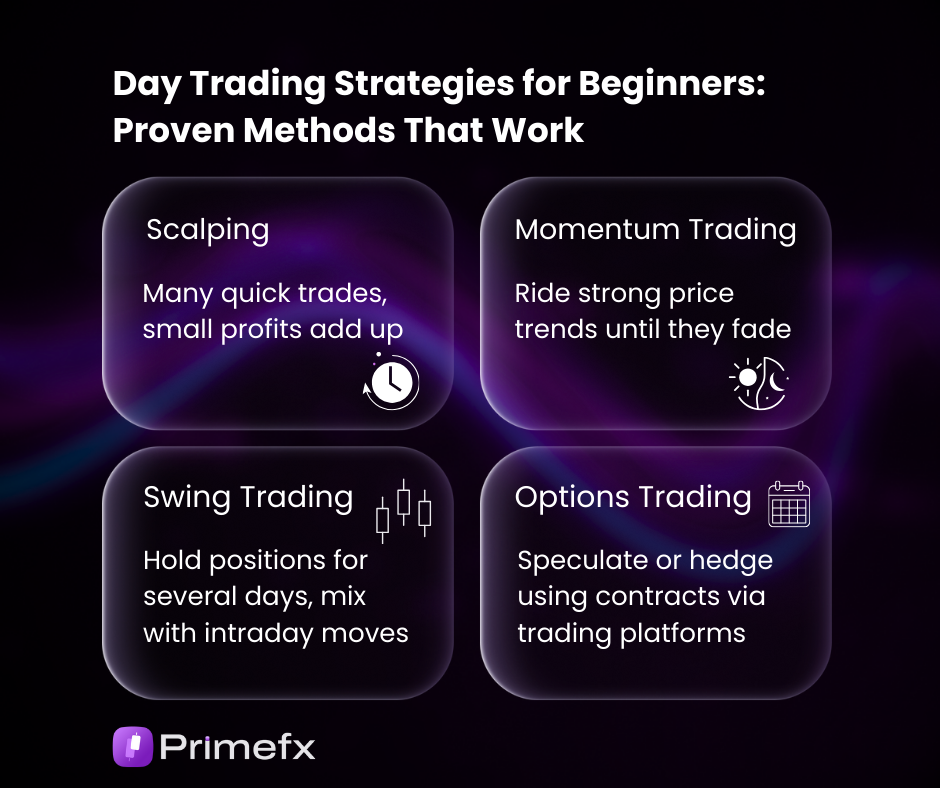
The following are some of the methods day traders use to navigate the markets.
· calping involves making tens of trades every day in order to make small gains over time.
· Momentum trading is when you look for strong price trends and ride them out until they lose their momentum.
· When you do swing trading, you hold on to your positions for several days, but many day traders mix swing factors with intraday trading.
· Options trading lets traders speculate or hedge using contracts, usually through a chosen options trading platform.
Any plan needs focus and practice to work. Beginners should try different tactics to see which works best for them, based on their personality, time constraints, and willingness to take risks.
Day trading for dummies is a simplified way of cramming. This is the concept of removing complexity and focusing on the essentials.
Begin with the study of one market at a time—say stocks or forex trade.
Learn fundamental chart patterns, including support, resistance, and moving averages.
Risk management practice.
Maintain a trading journal to record what you did, what happened, and what you learned.
This straightforward method helps beginners avoid being overwhelmed and build confidence over time. It is the foundation for becoming an amateur or professional trader.
It is not about fortune to make it as a successful day trader, but about habit.
Discipline: Stick to your trading plan, even when emotions urge you to deviate.
Risk management: Buy a stop‑loss order to save your capital.
Constant learning: Markets are changing, and strategies have to change.
Mindset: Avoid emotional, revenge, or overconfident trading.
If you are asking, “How to get into day trading?” The answer is simple: start small, build consistency, and scale gradually. Success comes from patience and persistence, not chasing quick wins.
The foreign currency trading (forex) market is the largest financial market. It is highly liquid and accessible, with trillions of dollars traded daily.
To begin forex trading, a trader should first learn about currency pairs such as EUR/USD or GBP/USD. Learn how interest rates, inflation, and geopolitical events affect forex currency trading. Trade in demo accounts first, then transition to live trading, and ensure you adhere to the professional forex trading framework: systematic risk management, defined strategies, and disciplined trading.
The opportunities in forex trading are international but require patience and a solid foundation.
Wondering how to trade forex? It works in a simplified form, as follows:
Open a regulated forex trading account with a regulated broker.
Select a trading exchange.
Analyze fundamentals (economic data) and technicals (charts).
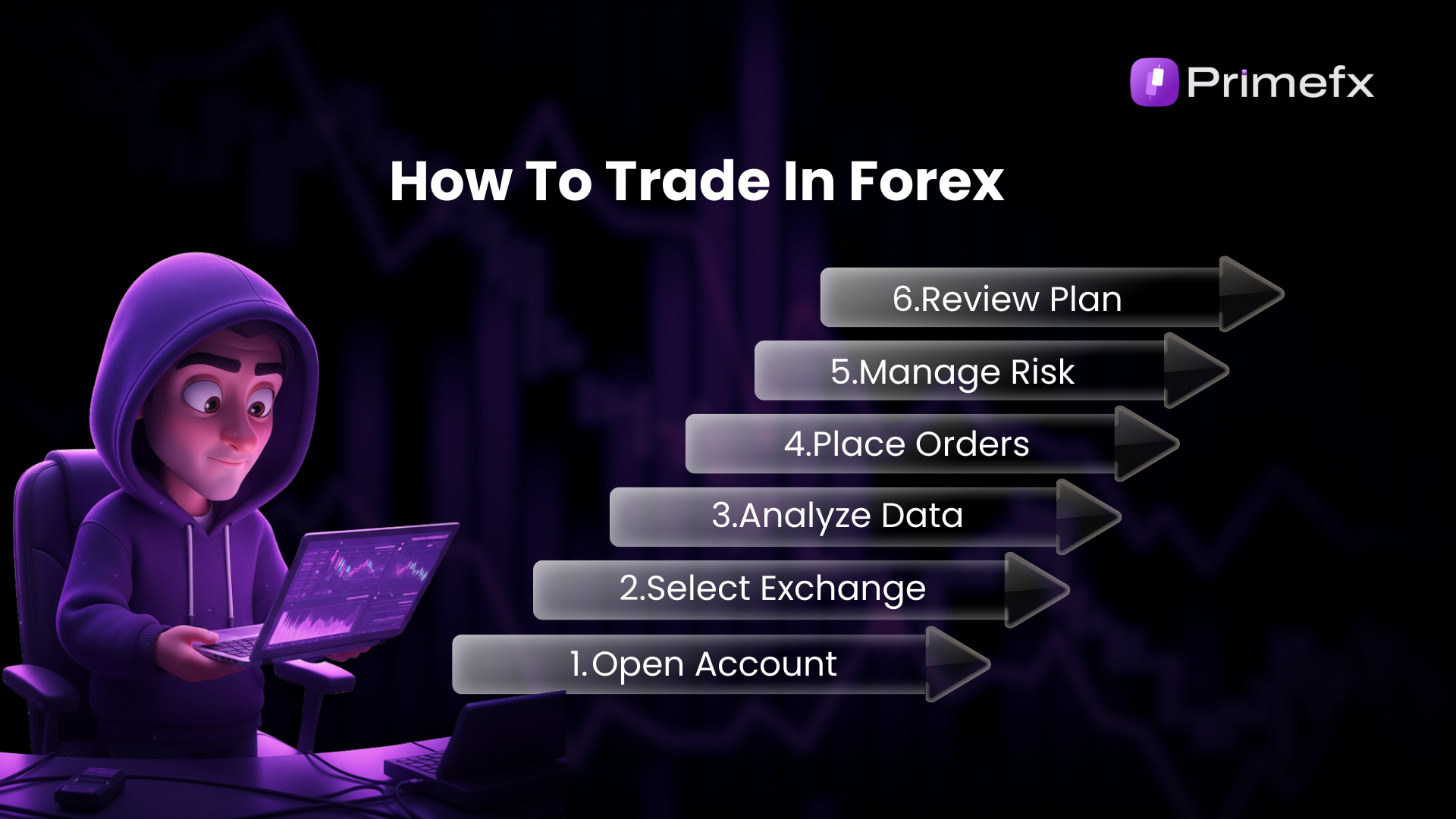
Place buy or sell orders depending on your forecast.
Control risk using stop‑loss and take‑profit levels.
Reconsider and clarify your plan.
A beginner in forex trading should always start with a practice account before moving to live trading.
There are communities such as Warrior Trading that offer mentoring sessions, live trading rooms, and formal courses. They enable novices to observe real‑time professional trading, which accelerates learning. Peer support also provides day traders with motivation and accountability.
Integrating community and personal practice builds confidence. For many beginners, the turning point that converts theory into practice is joining a trading community.
Day trading or forex trading is a choice depending on your objectives.
Day traders focus on intraday moves and prefer short‑term, fast‑paced trading.
Learn forex trading to gain exposure to international currencies and macroeconomic factors.
Both require patience, but forex is better suited to those who enjoy analyzing global events, whereas day trading is better suited to those who can act quickly.
It is not in vain before you dive into day trading. Rather it is good to know about trading signals. Signals serve as indicators or tips to help know when to buy or sell a currency pair. They can come from:
Technical analysis: moving averages, indicator charts, or indicators.
Fundamental analysis: News of interest rates, inflation, or world news.
Signal providers: societies or networks that exchange trade ideas in real time.
Consider signals as the traffic lights to traders. Green is a buy signal; red is a sell signal and occasionally the light remains yellow that means waiting.
Signals are frequently used by the beginners to understand timing and decision-making but one should not follow them blindly. Be directed, not controlled.
The distinguishing feature of Primefx is the accessibility and interest of trading education for beginners.
Clear blogs written in everyday language.
Charts and infographics that make patterns easy to see.
FAQs that answer common questions directly.
Competitive insights that fill gaps left by other platforms
This ensures that learners not only know about trading but also know when to apply it.
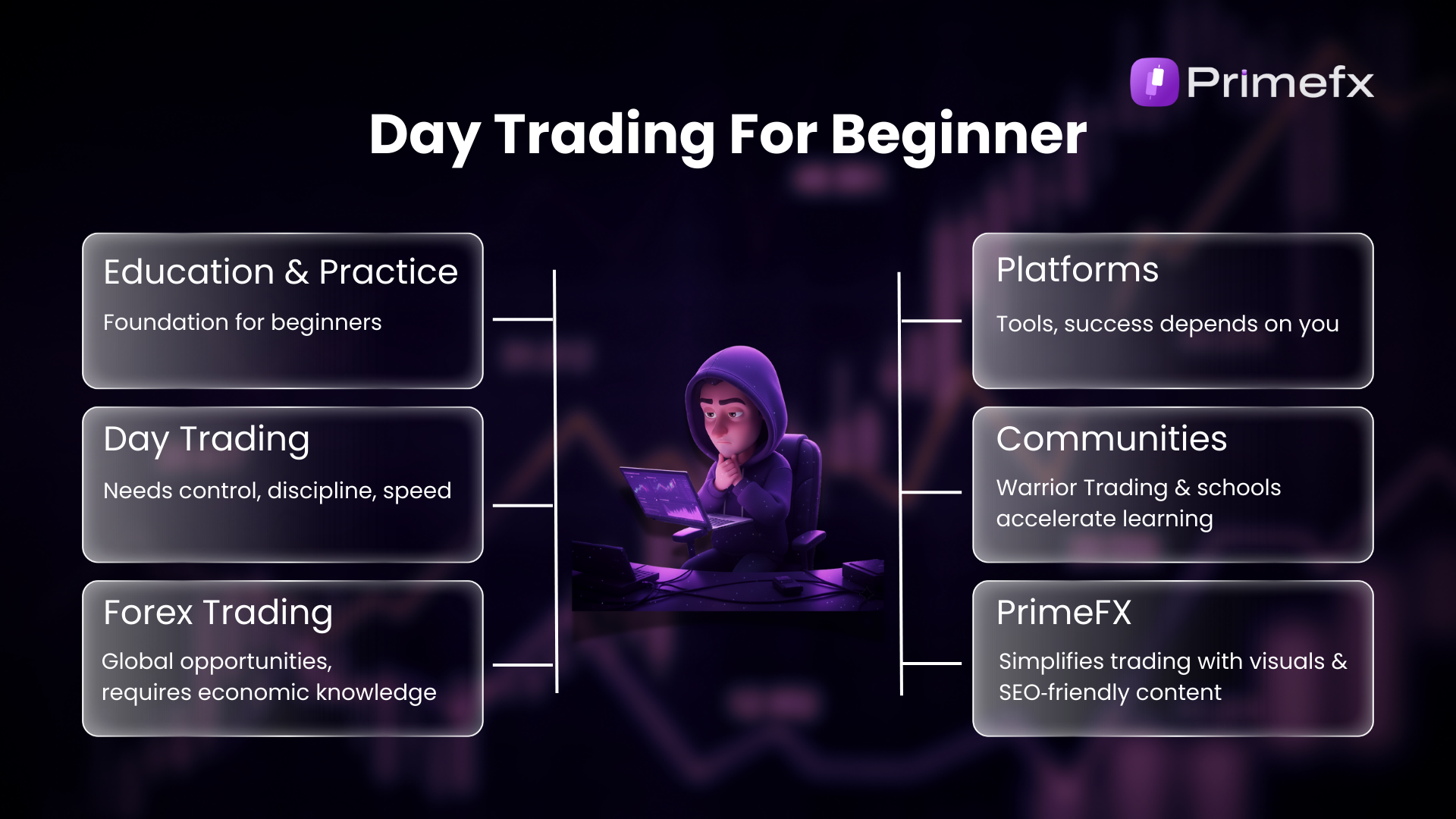
Learn the basics and practice first.
Day trading needs speed and discipline.
Forex offers global opportunities but requires economic awareness.
Platforms and communities are tools; success depends on you.
Primefx makes learning easier with simple, visual, and accessible content.
Trading is not a get-rich-quick project. It is an art that takes time, practice, and discipline. Whether you are new to day or forex trading or need to know how to start trading, the most effective path is organized learning, risk management, and continuous improvement.
Anyone can become a confident trader with the right mindset, tools, and guidance.
1. Can I make $1000 a day from trading?
Yes, there are others who make 1000 dollars/day as day traders, but it is not realistic when starting out. Skill, capital, and discipline are important for profits.
2. What is the 3-5-7 rule in trading?
The 3-5-7 rule is a simple mechanism for controlling risk:
Bet not more than 3 per cent of your account on a single trade.
Have no more than 5 trades in one day.
Stop trading when you lose 7 per cent in one day.
3. Is $100 enough to start day trading?
Yes, you can begin day trading with $100; forex trading is even more accessible, as brokers can accept small accounts. However, capital will be limited, and profits will be low.
Primefx shows beginners how to start with demo accounts and micro-trades to learn on a small scale before expanding.
4. What if I invest $100 a month for 10 years?
There can be 10 years of compounded growth, as investing 100 today can build a solid portfolio. An example is regular investments in stocks or forex that accumulate wealth over time.
5. How can I learn trading without risking real money?
This is best done using demo accounts or trading simulators. They allow you to trade in day trading and forex trading with virtual money at the beginning level.
6. What’s the best way to learn day trading?
Begin with formal education: read introductory resources, watch tutorials, and practice daily. Maintain a trading journal.
Primefx simplifies this by breaking complex issues into simple lessons, using charts and examples that beginners can follow.
7. Which provider has the best tools for beginners?
Primefx is designed for beginners. It provides clear blogs, FAQs, visual guides, and simplified explanations of trading concepts. Unlike many competitors, Primefx focuses on making trading accessible to everyday readers, not just professionals.
8. How do I open a trading account online?
It’s simple:
1. Choose a regulated broker.
2. Submit ID verification.
3. Add money to your account.
4. Start with a practice trade or a few small deals in real life.
Primefx offers reviews and step-by-step instructions to help people new to this process.
09. How do I become a professional trader?
To be a worker, you need to know what you're doing, have a plan that works, practice, and stay calm.
Primefx lets people who aren't good at these tasks practice them step by step, starting with easy steps and progressing to harder ones.

Sofia Alvarez is a professional market analyst and trading educator at PrimeFX Signal, with over 8 years of experience in Forex, Gold (XAUUSD), and major indices. She specializes in price-action and risk-managed swing trading, combining technical analysis, macro news, and strict risk controls to build clear, rules-based strategies for retail traders. At PrimeFX Signal, Sofia oversees trade ideas, reviews performance data, and writes in-depth guides on risk management, broker selection, and trading psychology so traders understand not just the signals but the logic behind every setup. Outside of market hours, she mentors developing traders through webinars and Q&A sessions, focusing on discipline, transparency, and sustainable long-term results in highly volatile markets.