Gold has fascinated people for centuries. From ancient coins to modern trading screens, it has always symbolized wealth and security.
In today’s global markets, gold (XAU/USD) is more than just a shiny metal. When economic uncertainty or geopolitical tensions shake confidence in currencies and stocks, investors often turn to gold as a safe‑haven asset.
But gold doesn’t move randomly. Its price is shaped by key factors like interest rates, central bank demand, inflation, and major economic events. Understanding these drivers helps traders avoid chasing noise and instead focus on real opportunities.
At Primefx, we believe trading gold is about more than reacting to headlines. It’s about combining technical analysis with macro insights, managing risk with stop‑loss orders and profit targets, and using tools like our exclusive Gold Heatmap to trade smarter.
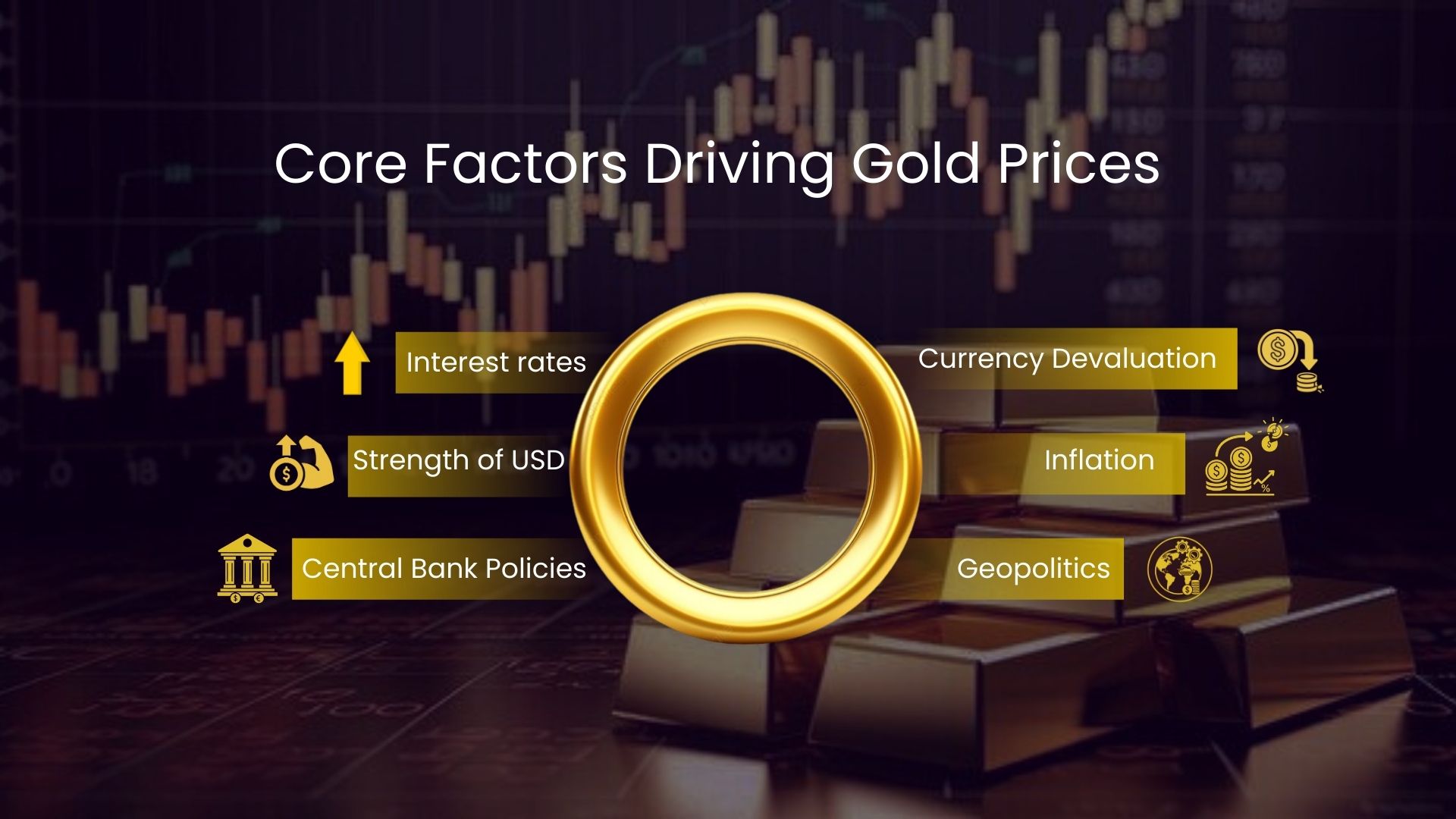
Interest rates and gold have an inverse relationship. Investors gravitate toward yield-producing bonds and savings accounts when interest rates rise. Gold becomes more appealing when interest rates drop because the opportunity cost of holding it vanishes.
The significance of consumer price index (CPI) releases and Federal Reserve announcements stems from this. Gold often rises, and the Fed may lower rates if the CPI shows inflation is slowing.
Gold may decline if the Fed tightens policy in response to a spike in the CPI. These actions can be anticipated by traders who monitor the release of economic data.
The gold-USD correlation chart is essential to view, as gold is priced in USD. Gold prices rise when the dollar declines because the dollar becomes less valuable, making gold more affordable for consumers worldwide.
On the other hand, demand is suppressed by a strong dollar. For gold traders, this tug-of-war between commodities and currencies is one of the most trustworthy signals.
The best inflation hedge is gold. Gold maintains purchasing power when fiat currencies depreciate due to currency devaluation. It is a key component of long-term portfolios because investors seek it out when the CPI is rising.
About 20% of all gold ever extracted is held by central banks. Their purchases and sales directly affect the price of gold in the global market.
As banks diversify away from USD reserves, demand has increased in recent years, supporting higher prices.
Wars, sanctions, and political instability create sharp price movements in gold. Gold serves as insurance during periods of significant economic uncertainty.
Traders can seize opportunities during these spikes by monitoring major news events and global market access.
Most blogs focus on the dollar, inflation, and interest rates. However, Primefx draws attention to more nuanced factors that actually influence gold prices:
Dynamics of ETF Flow: Outflows trigger corrections, while inflows drive prices higher. Abrupt changes are often attributed to retail sentiment.
Digital vs. Physical Gold: Bitcoin may be called “digital gold,” but physical gold remains more stable and globally accessible.
Commodity Supercycles: When demand is strong, gold rises alongside oil and industrial metals.
Climate and ESG Investing: Since gold is viewed as a neutral commodity, sustainability funds are discreetly increasing their allocations to it.
Liquidity Shocks: When investors are forced to sell gold due to equity margin calls, unanticipated volatility results.
Cultural Demand Cycles: Seasonal demand spikes in Asia and the Middle East are driven by weddings and festivals.
Impact of AI and Algorithmic Trading: Machine-driven tactics increase volatility during trading sessions, particularly during economic events.
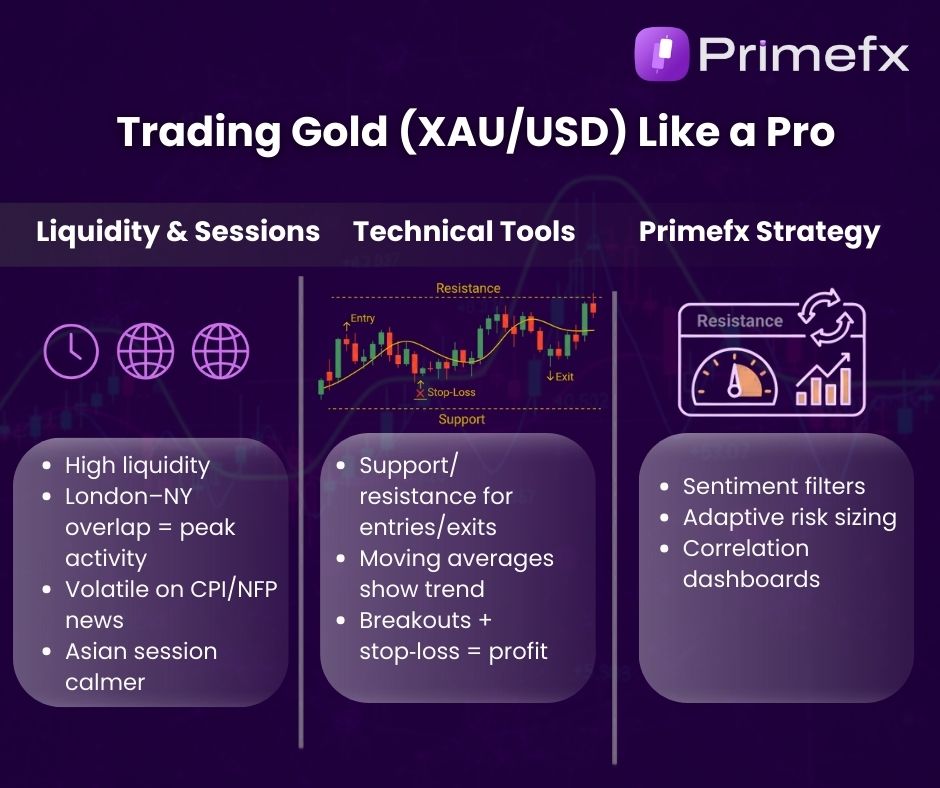
Although gold is one of the most liquid commodities on the foreign exchange market, trading it demands accuracy.
Gold offers high liquidity and global accessibility, particularly during the London–New York overlap. While volatility tends to rise during significant economic events such as CPI or NFP releases, the Asian session is typically calmer.
Support and resistance levels guide entry and exit points.
Moving averages help identify trends.
Trading breakouts during high volatility can be profitable when managed with stop-loss orders.
Proprietary sentiment filters to avoid false signals.
Risk layering with adaptive position sizes.
Dashboards showing correlations between gold, USD, oil, and equities.
Try these strategies in real time with Primefx’s trading account — suitable for all investors.
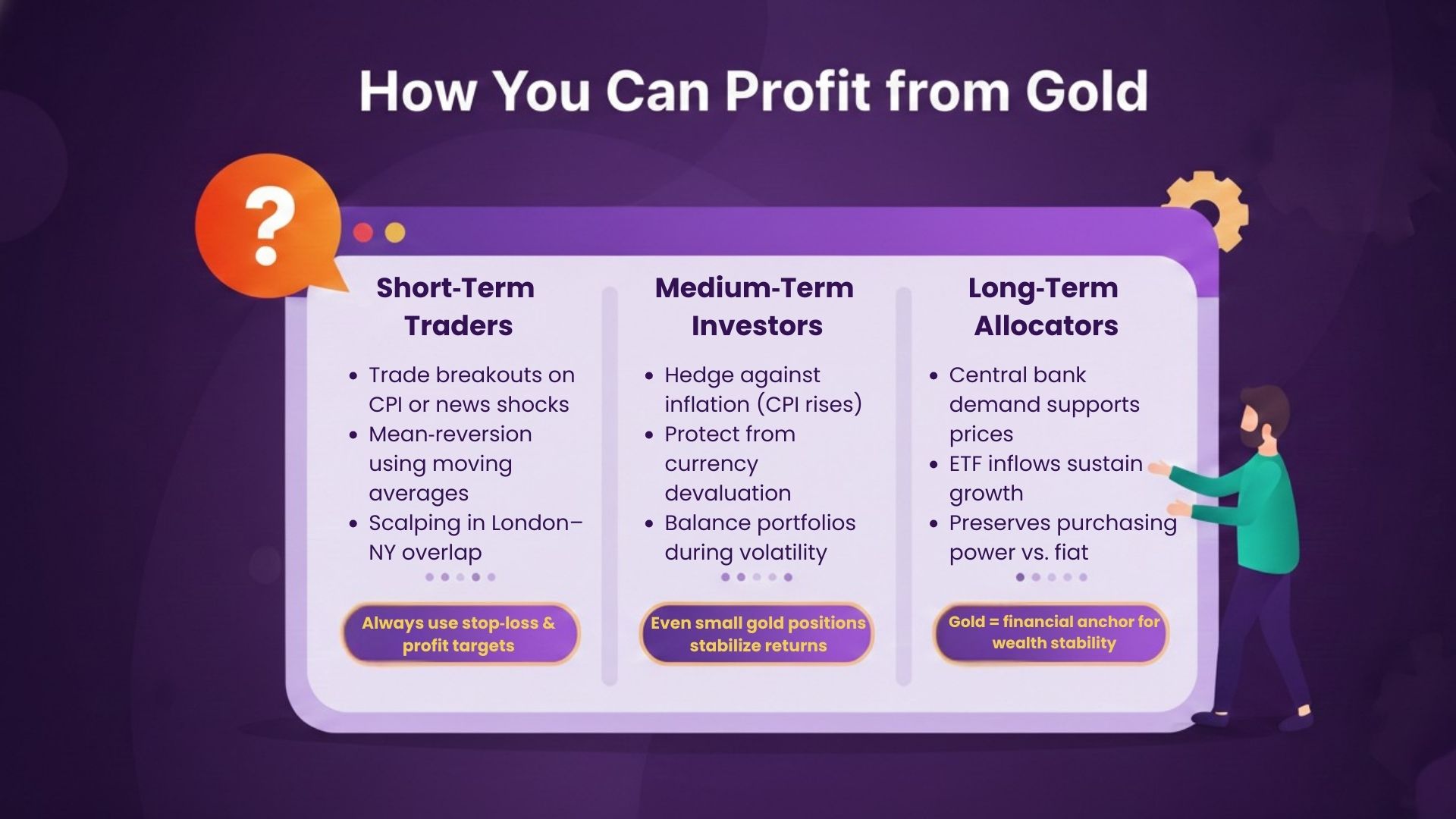
Gold is more than just a shiny metal; depending on your trading style and investment horizon, it can be used for a variety of purposes.
If you know how to use gold, you can make money whether you're a cautious long-term allocator or a quick-moving day trader.
Gold (XAU/USD) is one of the most thrilling assets for traders who enjoy market volatility. Major economic events, such as Federal Reserve announcements, the release of the consumer price index (CPI), or unexpected geopolitical tensions, can cause its price to fluctuate rapidly.
Trading Breakouts:
Traders can capitalize on the momentum when gold breaks above a resistance level or below a support level. For instance, gold might break through resistance if the CPI data shocks the market.
Gold frequently fluctuates within ranges. Using moving averages as a guide, traders can wager on a return to equilibrium when prices deviate too much from the average.
Scalping:
Scalpers profit from tiny, quick changes in XAU/USD during high-liquidity trading sessions, such as the London–New York overlap.
Primefx Tip:
Always set specific profit targets and use stop-loss orders. Risk management is the difference between profit and loss because gold can move quickly.
Gold is your insurance policy in a diversified portfolio. It is the traditional defense against inflation and the US dollar's depreciation.
Gold helps preserve the value of your portfolio as the CPI rises.
Gold maintains its purchasing power when the dollar declines or other currencies weaken.
Portfolio Balance:
During volatile market times, adding gold lowers exposure to stocks.
Primefx Tip:
Set aside some of your assets in gold through a trading account. In times of uncertainty, even a small position can stabilize returns.
Gold is about stability and wealth preservation for long-term investors.
To diversify their reserves, central banks worldwide continue to purchase gold. Prices are structurally supported by this rising demand.
Gold ETFs increase asset accessibility, and inflows often sustain rising prices over time.
Maintain Purchasing Power:
Gold retains its value over time, unlike fiat currencies, which are subject to inflation.
Primefx Tip:
Holding gold in your portfolio is like owning a financial anchor. It guarantees your wealth keeps pace with significant global economic changes and provides protection against economic uncertainty.
Gold adjusts to each type of investor:
Volatility is advantageous to short-term traders.
Investors with a medium time horizon protect themselves from currency fluctuations and inflation.
Long-term allocators use structural demand to protect wealth.
No matter your style, you can trade gold with confidence using Primefx's tools, which range from practice demo accounts to sophisticated dashboards displaying gold and USD correlation charts.
Let's say the Federal Reserve announces a rate cut while you're watching the news. Bonds suddenly lose their appeal, and investors rush into gold.
What takes place:
Because lower rates make holding gold less expensive, gold prices rise. Traders flood into XAU/USD as the dollar declines.
How to make money:
Use basic tools, such as moving averages, to identify the breakout.
To safeguard your position, place a stop-loss order slightly below the support level.
Establish a specific profit goal, such as $20 to $30 above your entry cost.
Case Study 2: Shock in Geopolitics
Imagine an unexpected conflict in the Middle East. Investors panic as headlines scream uncertainty.
What takes place:
Gold shines as the ultimate safe-haven asset amid plummeting stocks and fluctuating currencies. Within minutes, trading volume increases, and prices spike.
How to make money:
Keep an eye out for breakouts that surpass resistance levels.
Because volatility can be extremely high, keep your position size smaller than usual.
Use support and resistance to plan exits rather than guessing.
Primefx advantage:
You can distinguish between a real safe-haven rally and a transient spike with the aid of our sentiment filters.
Every case study demonstrates how gold responds to significant investor flows, geopolitical unrest, and economic events.
More significantly, they demonstrate how you, as a Primefx client, can use the appropriate tools and tactics to transform these moments into opportunities.
Gold remains both an opportunity and a hedge. Its price is influenced by interest rates, central bank demand, inflation, and geopolitical tensions, as well as overlooked forces such as ETF flows, ESG investing, cultural demand cycles, and algorithmic trading.
Whether you’re a short‑term trader chasing breakouts or a long‑term investor looking to preserve purchasing power, gold offers multiple ways to profit.
With Primefx’s tools, from demo accounts for practice to advanced dashboards showing gold and USD correlations, you can trade gold confidently and effectively.
1. How do you trade gold as a beginner?
Begin by understanding the factors that drive gold prices, such as interest rates, inflation, and the strength of the U.S. dollar.
Then create a demo account with Primefx to learn how to use such tools as support and resistance levels, moving averages, and our Gold Heatmap.
You can then upgrade to a live trading account once you are confident in your risk management.
2. Is trading gold profitable?
Yes, particularly during periods of extreme volatility driven by economic events or geopolitical tensions.
Traders profit through techniques such as breakouts, scalping, and mean reversion, whereas investors value gold as a hedge against inflation and currency devaluation.
3. Can you make money from gold trading?
Absolutely. Gold offers opportunities for both short-term traders and long-term investors. Using Primefx tools, such as sentiment filters and live dashboards, you can identify strong setups and execute trades with accuracy.
4. How risky is gold trading?
Gold trading is risky, particularly during high-profile news cycles. This is why stop-loss orders, position sizing, and monitoring the latest news on significant economic events are necessary.
Primefx offers built-in risk management tools to help you trade safely.
5. Why is the gold price rising today?
Gold can appreciate due to a weak USD, declining interest rates, rising inflation, or global uncertainty. The live Check Primefx dashboard provided updates based on economic data releases and Federal Reserve announcements.
6. How much gold can I buy for $10,000?
It will be based on the prevailing gold price. As an illustration, when gold has a price of 2,000 per ounce, there would be about 5 ounces of gold that would be purchased with one hundred thousand dollars.
Primefx's platform provides real-time pricing for position calculations.
7. Is gold trading worth it in 2026?
Yes, gold is a safe-haven investment and a potent tool for preserving purchasing power.
Most traders and investors are shifting to gold amid rising inflation and global uncertainty to seek profit and stability.
8. Who controls gold prices in the world?
There exists no single authority over the prices of gold. They are driven by global supply and demand, central bank policy, investor sentiment, and macroeconomic factors.
Primefx can assist you in monitoring these influences in real time.
9. What would $10,000 worth of gold look like?
Physically, it may be a few minor bars or coins in terms of purity and weight. On the digital platform, you can trade, monitor, and hold positions with full visibility into market conditions within your Primefx account.

Sofia Alvarez is a professional market analyst and trading educator at PrimeFX Signal, with over 8 years of experience in Forex, Gold (XAUUSD), and major indices. She specializes in price-action and risk-managed swing trading, combining technical analysis, macro news, and strict risk controls to build clear, rules-based strategies for retail traders. At PrimeFX Signal, Sofia oversees trade ideas, reviews performance data, and writes in-depth guides on risk management, broker selection, and trading psychology so traders understand not just the signals but the logic behind every setup. Outside of market hours, she mentors developing traders through webinars and Q&A sessions, focusing on discipline, transparency, and sustainable long-term results in highly volatile markets.