Signal providers in the hectic forex trading market claim to make the process a lot easier. They send the trade ideas to your inbox, Telegram, or trading platform. Sounds dreamy, right?
This sounds similar to having a personal chef who prepares well-cooked meals while you binge on Netflix.
The problem is, however, that when hundreds of services are competing to draw your interest, it becomes even more difficult to distinguish between the real value and marketing propaganda.
But the reality is not that hard. The answer to who should be the best provider of forex signals is not found in glittering promises or screenshots. Rather, it involves evidence, risk management, and trading style. It is about whether they align with your trading strategy.
This blog is a practical, neutral checklist to help you evaluate before spending any money on a signal service. Use this forex shopping list to avoid buying anything that goes against your strategy.
Forex signals are potentially strong tools. However, they are risky. Unreliable reporting, dangerous practices, or poor performance can be concealed by a provider's glossy marketing.
A checklist will not win you anything, but it will help you to avoid that statistic.
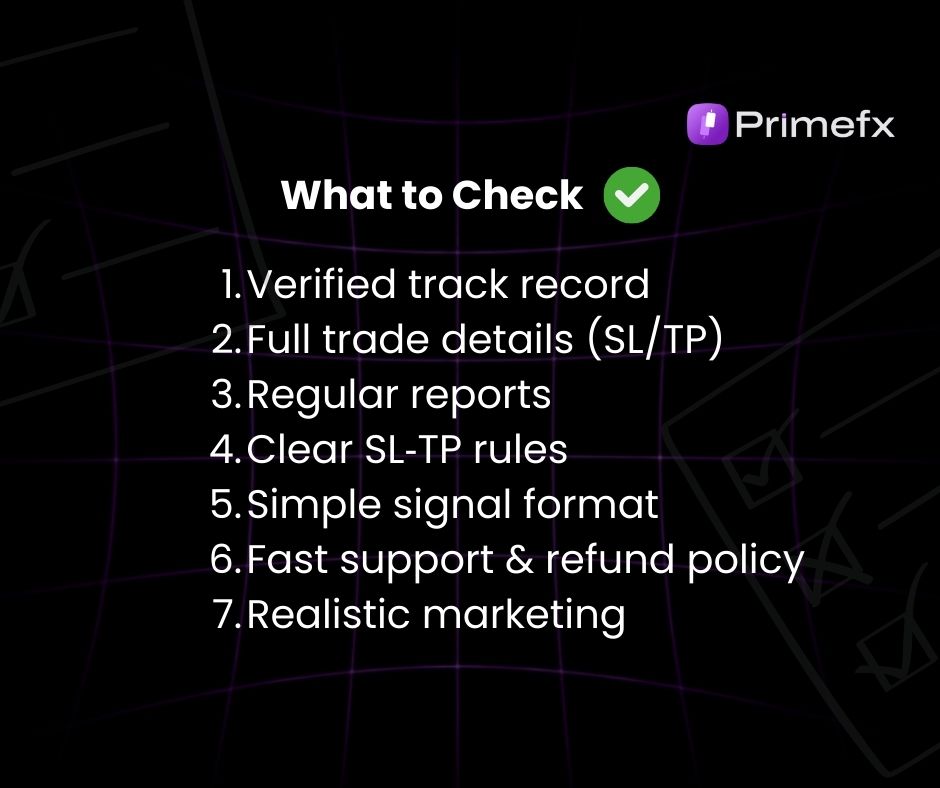
This guide simplifies the six important areas that any trader must check before subscribing:
· Proof & verification
· Reporting & transparency
· Risk rules
· Signal clarity & execution
· Support and service availability.
· Reputation & alignment
Auditable track record: Seek third-party confirmation (e.g., Myfxbook, fx Blue). Mere screenshots are just as reliable as a magician pulling rabbits out of a hat.
Detailed reporting: Tallies must include dates, entry prices, stop-loss (SL), take-profit (TP), and final results, not cherry-picked wins alone.
Slippage awareness: Inquire whether they account for slippage. What seems profitable on paper may not be profitable in actual execution.
Example: A provider states they have a 90% win rate. Sounds amazing, right? But go deeper: When those trades are scalps with a 2-pip target, and you are trading with a 3-pip slipping broker, you were just playing darts with a blindfold over your eyes.
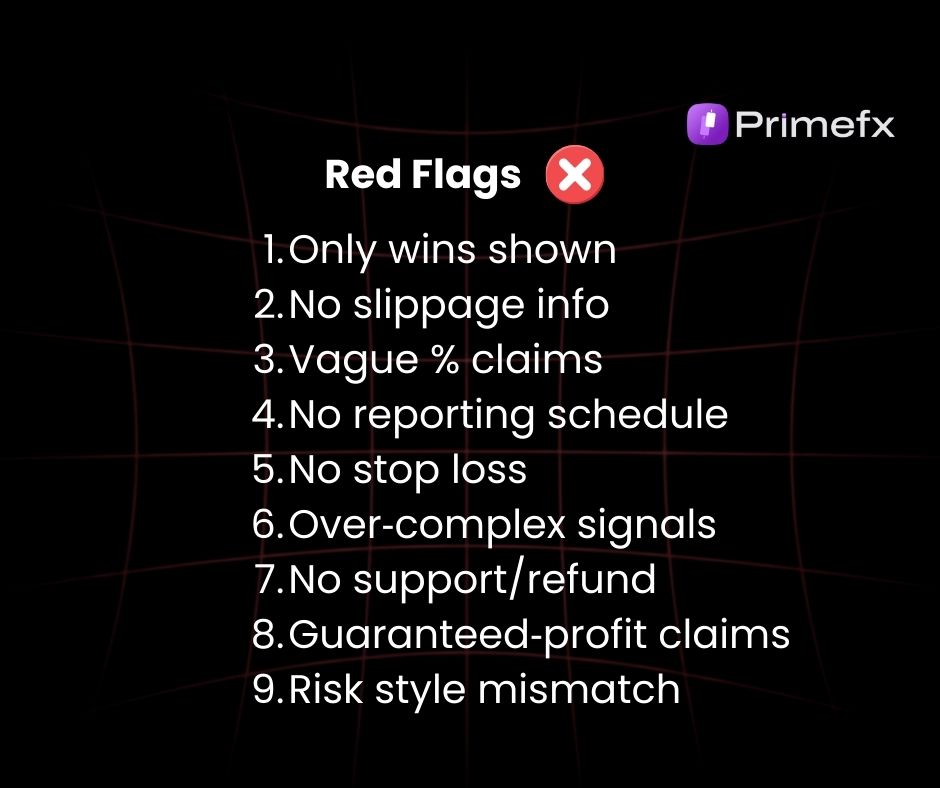
· Just displaying winning trades
· No slippage or execution difference mentioned.
· Findings in the format of obscure percentages without specifics of the trade (We made 200 per cent last month! But what is the sum?
Regular reporting: Weekly or monthly reporting of such metrics as the win rate, the average risk-reward (R: R), the drawdown, and the losing streaks.
Closed vs. open trades: Providers must ensure that open trades are clearly labelled to avoid confusion.
Strategy disclosure: Is it scalping, day trading, or swing trading? Frequency matters—five trades a day vs. five trades a month should not carry the same expectations.
· No reporting schedule (as with a TV show that promises episodes and never shows them).
· Just presenting closed trades in isolation.
· Vague descriptions of strategy (We trade everything, but we do not want to explain).
Stop-loss and take-profit levels: There should be stop-loss and take-profit levels for every trade.
Position sizing advice: Specific guidelines on the percentage of risk taken in each trade, the maximum loss allowed in a single day, and the stopping point of trading.
· Signals without a stop loss.
· Promoting fat-cat jobs.
· Strategies are used secretly.
Clean format: Instrument, direction, entry, SL, and TP levels.
Routine compatibility: Signals must align with your time zone, holding time, and daily trading volume.
Copier specifics: Does it have auto-copying? Inquire about supported brokers, latency, and partial fill handling.
· Alcoholic clues (buy EUR/USD soon).
· Excessively complicated multiple TP instructions.
· Copier set-up that is compatible.
Quick reaction time: particularly important in volatile markets.
Installation support: Set up MT4/MT5 and copiers.
Refund/cancellation policies: Written, easily available, and equitable.
· There is no external customer service.
· Neither visible nor clear policies on refunds.
· Slow reactions to market occurrences.
Marketing that is realistic: No claims of guaranteed profit.
Community feedback: Feedback beyond their channel.
Risk tolerance test: Aggressive or conservative: What is your style?
· No independent feedback.
· Incompatible risk styles (e.g., you are conservative, and they are aggressive traders).
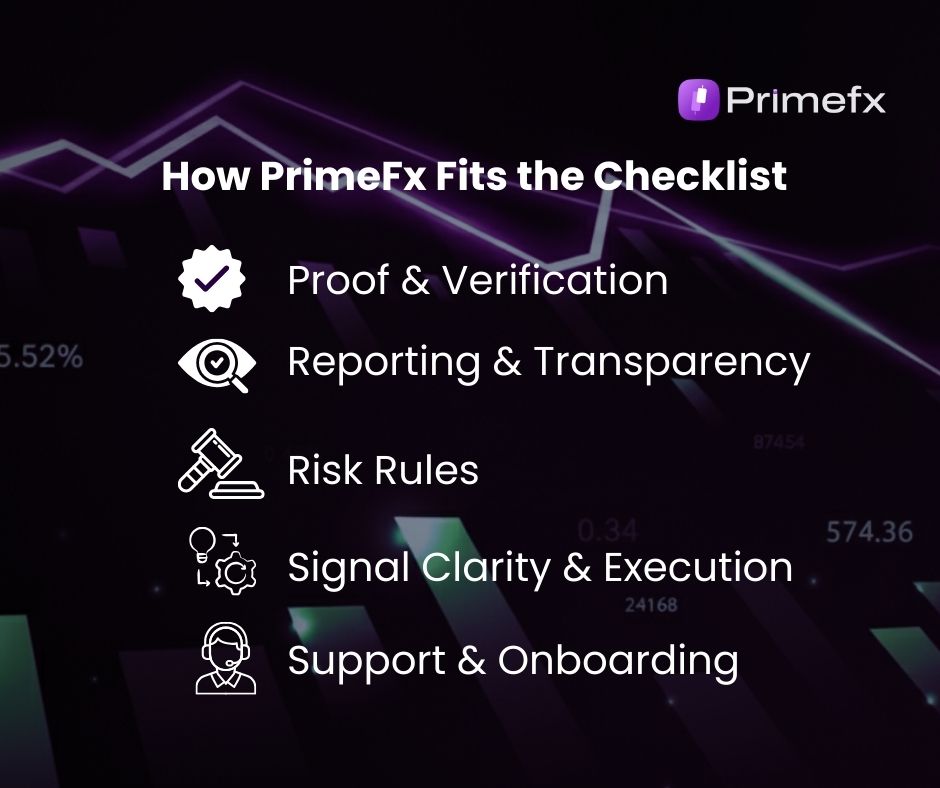
To see how this checklist is applied in practice, we can map it against Primefx's operating model.
Proof & Verification
Primefx focuses on transparent reporting and updates. If there is third-party verification, it should be highlighted as the strongest indicator of trust.
Reporting & Transparency
Internal linking to other pages is structured as a hub. Primefx's reporting structure makes it easier to audit results and assess performance data.
Risk Rules
The standard model of Primefx is 1 SL - 1 TP, which makes execution easier and less confusing than multi-TP instructions.
Signal Clarity & Execution
The clean 1 SL/1 TP generates clear, simple signals for Telegram, MT4, and MT5 users.
Support & Onboarding
The model of customer communication at Primefx focuses on quick replies and installation instructions—perfect for traders who require assistance in copiers and installation of the platform.
· Forex signal providers can save time, but they're not magic bullets.
· Verification is your safeguard against hype.
· Manual vs. copier depends on your schedule and risk appetite.
· Avoid scams by demanding transparency and realistic claims.
Choosing the right forex signal provider isn’t about chasing “guaranteed profits.” It’s about confirmation, evidence, risk rules, professionalism, support, and reputation. With such a checklist in hand, you can protect yourself from flashy hype and start with providers that genuinely fit your trading style.
Primefx is simply a live example of how a provider might align with these requirements. But ultimately, the responsibility lies with your own due understanding.
And here’s the key reminder: signals are just the tools, not any magic wands. Think of them as GPS directions. They can guide you toward the destination, but you’re still in charge of steering the wheel. Without your own discipline and risk awareness, even the best signals won’t keep you on the right path.
Call to Action: Ready to put this checklist into practice? Explore providers with transparency, track their performance, and match their trading style to yours.
If you want to see how Primefx develops signals with clarity and support, check out their reporting hub and start evaluating with confidence today.
What is a forex signal provider?
A forex provider is always your tipster when it comes to trading. They post trade recommendations, including entry price, stop-loss (SL), and take-profit (TP), via Telegram, email, or directly in MT4/MT5 via a copier.
Imagine it is a GPS for trading. The company directs you where to enter and exit, but it is up to you whether to use the road. There are scalping providers (quick trades) and swing trading providers (longer holds).
Fun fact: According to polls, more than 60 per cent of retail traders use external indicators at some point in their trading careers, particularly during their first steps.
Why is verification important?
Verification is the main distinction between a chef's actual recipe and a random food blogger's claim to have invented it.
Similarly, without third-party verification, you are relying on screenshots that can be photoshopped within minutes.
· Third-party sites such as Myfxbook or fx Blue are the gold standard. They monitor accounts in real time and indicate confirmed performance.
· A provider is supposed to have not only wins but also losses, drawdowns, and streaks. This is why transparency is important.
Example: It would seem that a provider with a 95 per cent win rate is great. However, when they lose by an average of 10 times more than they win, you are just purchasing lottery tickets. These imbalances are revealed through verification.
Should I take a manual sign or a copier?
It will be according to your lifestyle and trading routine:
Manual signals: This is where you are alerted to and manually place trades. You have to be attached to your phone or computer at all times.
Copier indicators: The trade occurs automatically on your account. Easy when you are not in a hurry or in a different time zone. However, be mindful of the risks: a 5-second delay can cost a winning scalp.
Bizarre analogy: Manual signals can be analogised to cooking with a recipe; you add the recipes yourself. Copiers are like takeout: you get the food immediately, but you don't have the spiciness.
How do I avoid scams?
The forex market is not short of get-rich-quick promises. In order to prevent scams, remember the following rules:
Clear reporting: Weekly or monthly statistics, win rate, risk-reward ratios, and drawdowns.
Marketing in the real world: No promises of high profits or doubling your account in 7 days.
Community Feedback: Search external reviews, not on their Telegram feed or site. Standalone forums and social media gossip are more trusted.
Refund policies: The authentic providers specify the cancellation and refund policies.

Sofia Alvarez is a professional market analyst and trading educator at PrimeFX Signal, with over 8 years of experience in Forex, Gold (XAUUSD), and major indices. She specializes in price-action and risk-managed swing trading, combining technical analysis, macro news, and strict risk controls to build clear, rules-based strategies for retail traders. At PrimeFX Signal, Sofia oversees trade ideas, reviews performance data, and writes in-depth guides on risk management, broker selection, and trading psychology so traders understand not just the signals but the logic behind every setup. Outside of market hours, she mentors developing traders through webinars and Q&A sessions, focusing on discipline, transparency, and sustainable long-term results in highly volatile markets.